
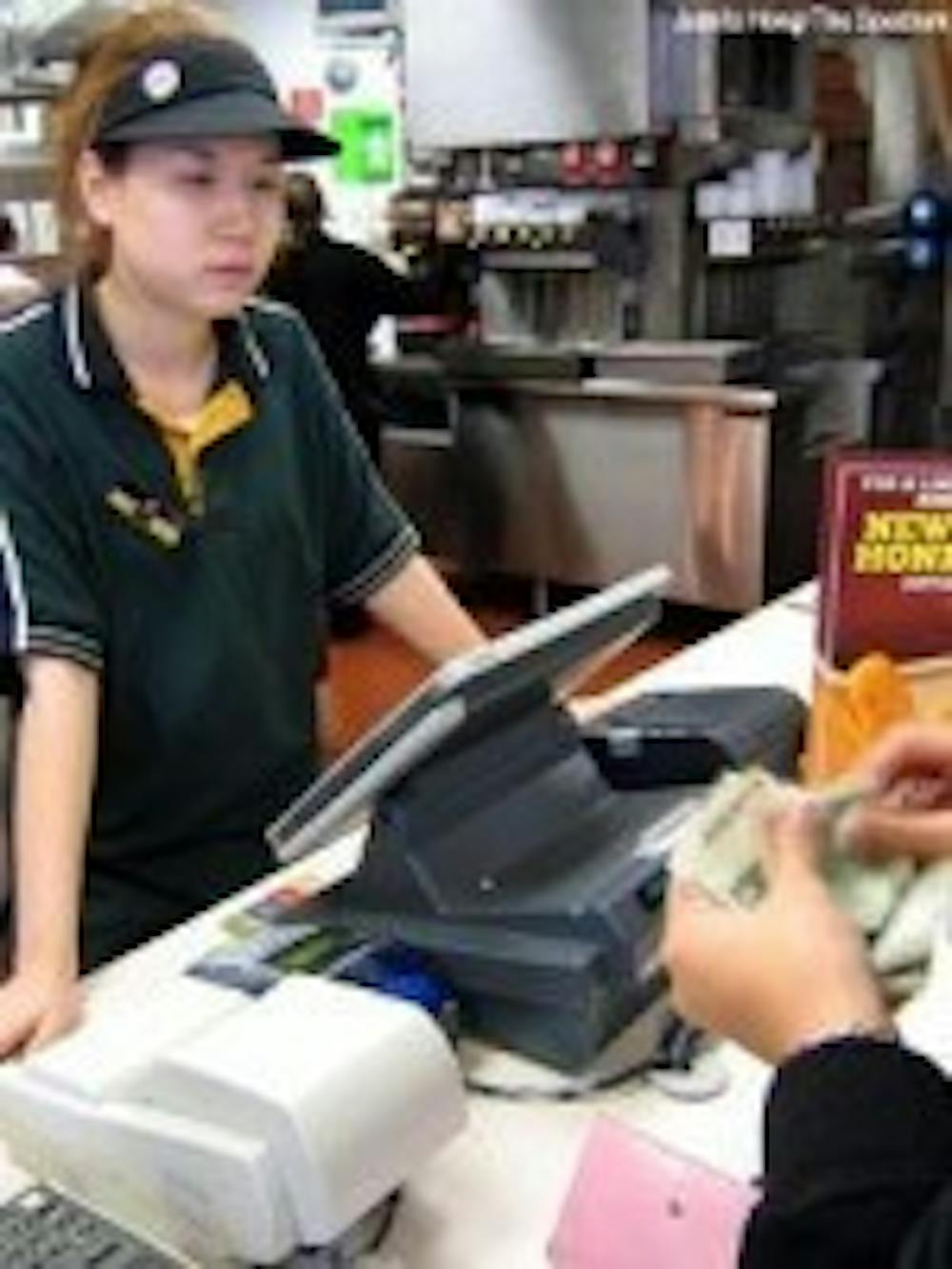
Sean Jackson, a sophomore employee at the on-campus Burger King in The Commons, just got a raise without even asking for it.
With the second phase of a three-tiered New York State plan to increase the minimum wage going into effect on Jan. 1, New Yorkers, including Jackson and 360,000 other hourly employees, now earn at least $6.75 an hour, up 75 cents from last year.
"Yeah, I make minimum wage," said Jackson, a political science major when he's not asking customers if they want fries with that.
As a newer employee at the restaurant, Jackson said he had not yet received a raise that brought him above the state minimum before the first of the year, but the money is a welcome addition to help pay for things like the high cost of gas.
"Why wouldn't it be better? It's more money," Jackson said.
Some employers on campus, however, have to figure out different ways to pay their staff the higher rates and are looking in different places to make up for the new expense.
Julie Fack, a restaurant manager over Jackson at the on-campus Burger King, said that her store had to pass some of the burden along to the customers.
"The thing we did was raise some prices," Fack said.
Jackson said that with the wage increase, Burger King would still get some of its hourly rate back. Most of the employees will be paying a little more because of price increases to eat at work, even after their employee discount.
Looking at wage increases as just one part of overall inflation is not only how Jackson judges the cost of his lunch on his break, but it's also how Nancy Miloff said she sees all of her expenses.
"We've really tried not to raise the prices," said Miloff, owner of the Campus Caf?(c) adjacent to Burger King. "We've cut other places instead."
With the higher cost of product shipping because of gas, Miloff said her overhead expenses have gone up across the board. Her employees were already making more than minimum wage, she added, but the new rate will have an effect on new hires.
Neither the on-campus Burger King nor the Campus Caf?(c) had any layoffs as a result of the wage hike, but Burger King did cut back on a few hours and shifts.
This minimum wage increase is part of a three-year plan approved by the New York State Legislature to bring minimum wage up to $7.15 an hour by January 2007. The rate had been $6 an hour since the beginning of 2005. Before the plan went into effect, the minimum wage had stayed at $5.15, the federal minimum, for five years, according to Article 19 of the New York State Labor Law.
Restaurant servers, who receive a lower minimum wage because their pay is supplemented by tips, saw an increase to $4.35 an hour this year. Server pay had previously been set to $3.85 an hour in 2005, and $3.30 before that. Their rate will increase to $4.60 in 2007.
In New York, overtime pay is still one-and-a-half times the hourly rate for work over 40 hours in one week.
According to the U.S. Department of Labor, Pennsylvania minimum wage is $5.15 an hour, Vermont is $7.25 an hour, Massachusetts is $6.75 an hour, Connecticut is $7.40 an hour and New Jersey is $6.15 an hour.
Ohio and Kansas are below the federal minimum wage level, and are therefore automatically raised to $5.15 an hour. The same applies to Arizona, Louisiana, Mississippi, Alabama, Tennessee and South Carolina, all states that do not have any minimum wage laws.



