
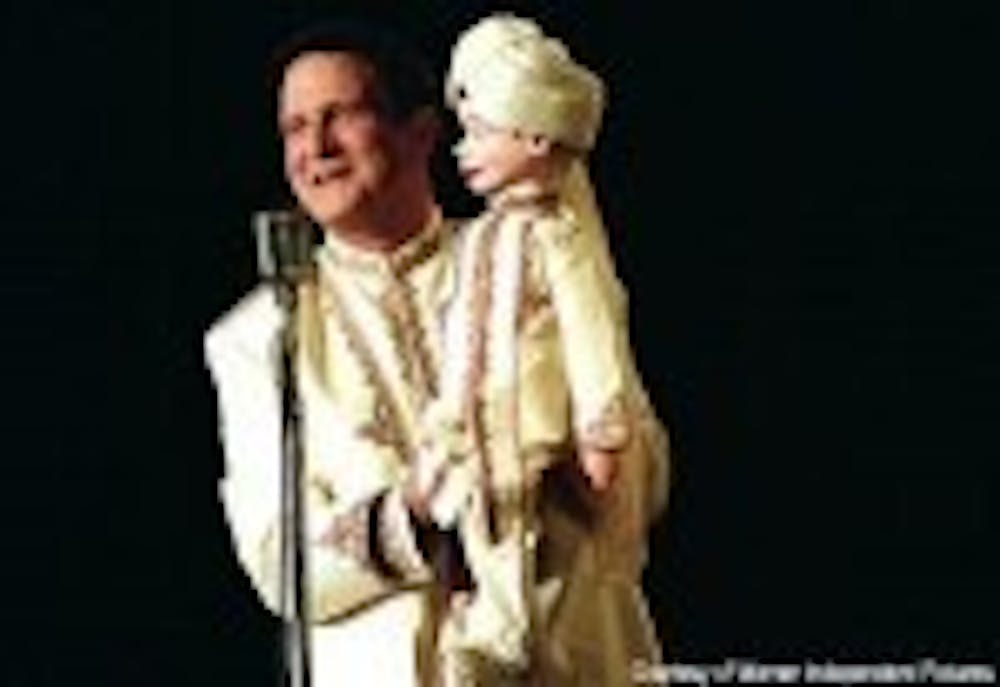
Comedian Albert Brooks completely monopolized the creation of "Looking for Comedy in the Muslim World." He fills the role of screenwriter and director, as well as taking the liberty of playing himself.
The movie begins with an asinine assignment given by former Tennessee Senator Fred Thompson, who recruits Brooks to conduct a study of Muslim humor in order to augment the United States' intelligence of the Middle East.
Based on the premise of the movie, viewers may be mislead into thinking that the plot line is garnished with substantial comedy. Disappointingly, Brooks' portrayal of himself as a standup comedian is more demeaning than it is accurate.
In 2003, the satirical film "Lost in Translation" took advantage of shooting in Tokyo to highlight the differences between the Japanese and American cultures. Brooks' "Looking for Comedy" applies the cultural confusion but does not take advantage of aesthetic value of India.
His self-deprecating style is also reminiscent of Charlie Kaufman's "Adaptation," in which Nicholas Cage portrays the neurotic and self-loathing demeanor of Charlie Kaufman. Do not be mistaken, though. Comparing "Adaptation" to "Looking for Comedy" is like comparing apples to bicycles.
With consideration to Brooks' lavish career, which includes numerous appearances on "The Tonight Show" with Johnny Carson, Brooks suppresses his sense of humor in order to satisfy plot structure.
The dialogue between Brooks and his wife (Amy Ryan, "Capote") comes across as contrived. The supporting actors, such as the State Department agents played by John Carroll Lynch and Jon Tenney, and his Indian assistant Sheetal Sheth ("American Chai") generate flaccid chemistry, and their actions are as unconvincing as the dialogue is unnatural.
The movie's intentions are admirably satirical. Brooks attempts to invoke his political/social agenda by smartly observing that fear will oftentimes fraternize with laughter.
His mission to reveal what makes Muslims laugh is fatally misinterpreted as a nuclear threat by Indian officials, and re-sparks hostility between India and Pakistan.
In the meantime, Brooks returns home and nonchalantly tosses back champagne with friends and family while the news of rising nuclear tension in the Middle East serves as background noise.
Brooks' attempt to launch humor into the post-9/11 atmosphere may have been more laudable were it not for the talent of his predecessors. The combination of "Team America: World Police," by Trey Parker and Matt Stone, and Michael Moore's "Fahrenheit 9/11," makes it very difficult for Brooks to beget any shock value. "Looking for Comedy" frailly shivers in the shadow made by Jon Stewart's fresh and frequent political satire found within "The Daily Show."
He lazily spoon-feeds himself culture-clash comedy and has no shame when it comes to cluttering his film with stereotypes. Every time Brooks goes to his office he passes by a room brimming with Indians on telephones, as the audience is able to overhear such sound bits as "thank you for calling Onstar," or "try rebooting your computer."
Jon Stewart could have delivered Brooks' entire satirical effort in a five-minute rant. This film seems like a "Daily Show" joke that lasted too long. He brings important issues to the forefront, but is not successful at holding the viewer's interest.



