
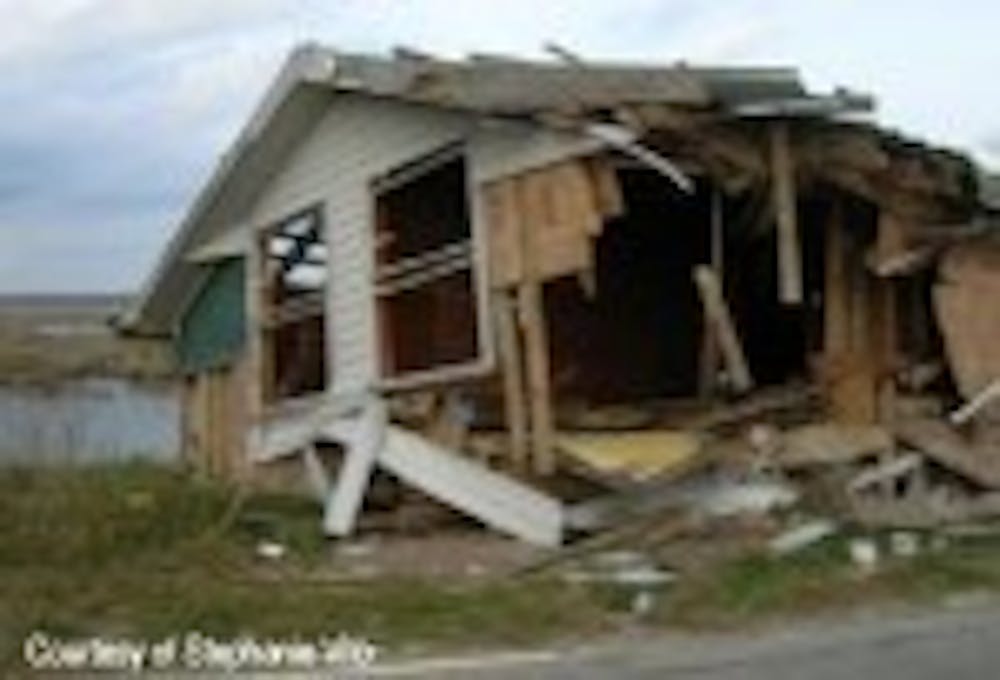
Four months after Hurricanes Katrina and Rita thrashed New Orleans, images of the destruction seem to have trickled out of much of the American consciousness, or at least out of the daily news cycle.
For Nathaniel Cornman, a junior architecture major at UB, the images that faded for some people became stark reality when he and other UB students went to Louisiana over their winter break.
"From the time you wake up until the time you go to bed, all you see is hurricane destruction," Cornman said. "The roads and highways are still lined with trash and debris. There are still boats everywhere. The highway is still lined with cars from when everyone was evacuating, and it's been four months."
Cornman was one of 21 UB students who spent winter break just outside of the New Orleans Ninth Ward in Chalmette, La., clearing out the muck that had been stewing there for months.
Cornman organized the trip with help from his church, the Clarence Church of Christ. He said that when the group reached the area, he and his fellow students did a lot more cleaning and tearing apart than rebuilding.
"When we got there, we figured pretty much all of what we'd be doing is cleaning out houses," Cornman said. "They're just not ready to start building yet. (Hurricane victims) don't know where to start because they're living as far away as Texas. They've been sitting there for four months. One family had an eight-hour drive just to clean (their home) out.
He said the families were not able to do everything on their own and have not yet had a great deal of help.
"To do it by yourself, it's an unreal task. We talked to a man, he was a strong guy, and it took him an entire month to do it by himself," Cornman said.
"There was 15 feet of water, three feet of mud and snakes, there was everything," said Kathy Bass, director of East St. Tammy Habitat for Humanity, who worked with the students in their efforts. "They went in there and cleaned these houses out. They did the hardest, dirtiest job and they did it every day."
In the New Orleans-Louisiana region, the word "muck" has become part of daily vocabulary, as the locals use the term to describe all of the water, mud and destroyed possessions, Bass explained.
" 'Mucking' is the term used to empty all of the contents of the interior of the house to the street," she said. "All of the contents, from personal possessions to external uninvited items, to sheetrock and insulation."
The process of rebuilding started with mucking. There was usually nothing salvageable in the homes, and the large appliances, furniture and personal items all had to be removed before the mud could be cleaned up, according to Cornman. The drywall and insulation then needed to be taken out from the hurricane-stricken homes, stripping the walls down to the studs.
"The reason we gut houses, for the most part, is because there's such a need for that right now," Cornman said. "I don't even feel that the pictures really describe it that well. There's nobody in that area really now."
The students from UB did a great deal of work for people who were in serious need, Bass said.
"The destruction in (Chalmette) is beyond description," she said. "Flood waters went over the roofs of most homes. Their homes still hold all of their possessions and a layer of mud. Many are not physically able to do the work, and the average cost to have your house gutted is $5,000."
Dennis Cook, a junior architecture major, said it didn't take long for it to become apparent that the people needed dire help.
"I didn't expect to see what it was," Cook said. "It was a huge shock; it's still in really bad shape. They really need a lot more volunteers to come down because it's such a huge job. People just now are just coming back to see their houses."
Cornman said the area was in such bad shape that roads didn't even seem like roads -- they were covered in water, mud and debris. Rows of houses would be gone, with only a foundation left.
"There are houses everywhere except where they should be. There were a few times we were walking down the street and you couldn't tell it was a street. That, emotionally, was hard to walk through."
He said the nine families the group helped were very thankful, feeling that everyone had accomplished a great deal.
"It definitely hugely changed a lot of the people that I talked to from the trip. It changes your idea of materiality and possession and just like what you feel is important because with most families from down there, the only thing they have left is family."
As politicians talk about the logistics of rebuilding the city, Cornman said the trip really shed light on the situation.
"You hear people that say 'You might as well bulldoze the entire city.' When you're down there and you talk to people, you realize that it was such a tight community. Everyone had grown up there and still lived there. The hardest thing that everybody talked about is that they want to see their friends and family, but they're scattered across the U.S.," he said.
When people asked him about the status of the city once known as "The Big Easy," Cornman said although downtown had become functional and is returning to normal, most local businesses still hadn't returned in the outlying areas.
"As soon as you step outside of downtown, it's still complete and total hurricane destruction," he said.
Cornman described the hospitality and kindness of the people that the students helped as "unreal" and said he wished he could have stayed longer and wishes to help more.
"The biggest thing we wanted to put together when we came back, was that we wanted to convey to people that there really is a huge need for volunteer workers down there. If people are able to go down there, then they really should," he said. "The news is not showing what it's really like down there."
There were a lot of health concerns for volunteers going on the trip, according to Bass. They had to wear jumpsuits, respirators, gloves and boots heavy-duty enough to keep feet safe from nails and other sharp objects.
Robert Szudzik, a first-year architecture graduate student, also spent his break helping out.
"My whole life I've never really been exposed to that sort of environment. The land and the geology out there is so different from here. The learning experience is to see what a type of environment can do to the neighborhoods and a lifestyle," Szudzik said. "I think pretty much everyone should go down there and see how their lives have changed."
Szudzik said that he and the others learned a lot about life and the unexpected things that can happen. Although the Southern states and the allure of warmer weather may seem attractive to many students, he warned about the dangers of everyday life in some warmer climates - such as hurricanes.
"The students learned a lot about the anatomy of the house, taking them apart and that sort of thing," he said. "That's another side of it."
Both Szudzik and Cornman said they hope there are students who might be interested to take part in future trips.
"If other students are looking to get into the area, they should," Szudzik said. "It's really something they can take something from."
"After (the students) mucked the houses and they walked back in, it was almost home again," Bass added. "It was better than whether or not they could ever move back, it gave closure. What they did was much bigger than if they will replace the houses or not. The emotional toll that this has taken on my co-workers has been big, and everyone from Buffalo was a big help."



