
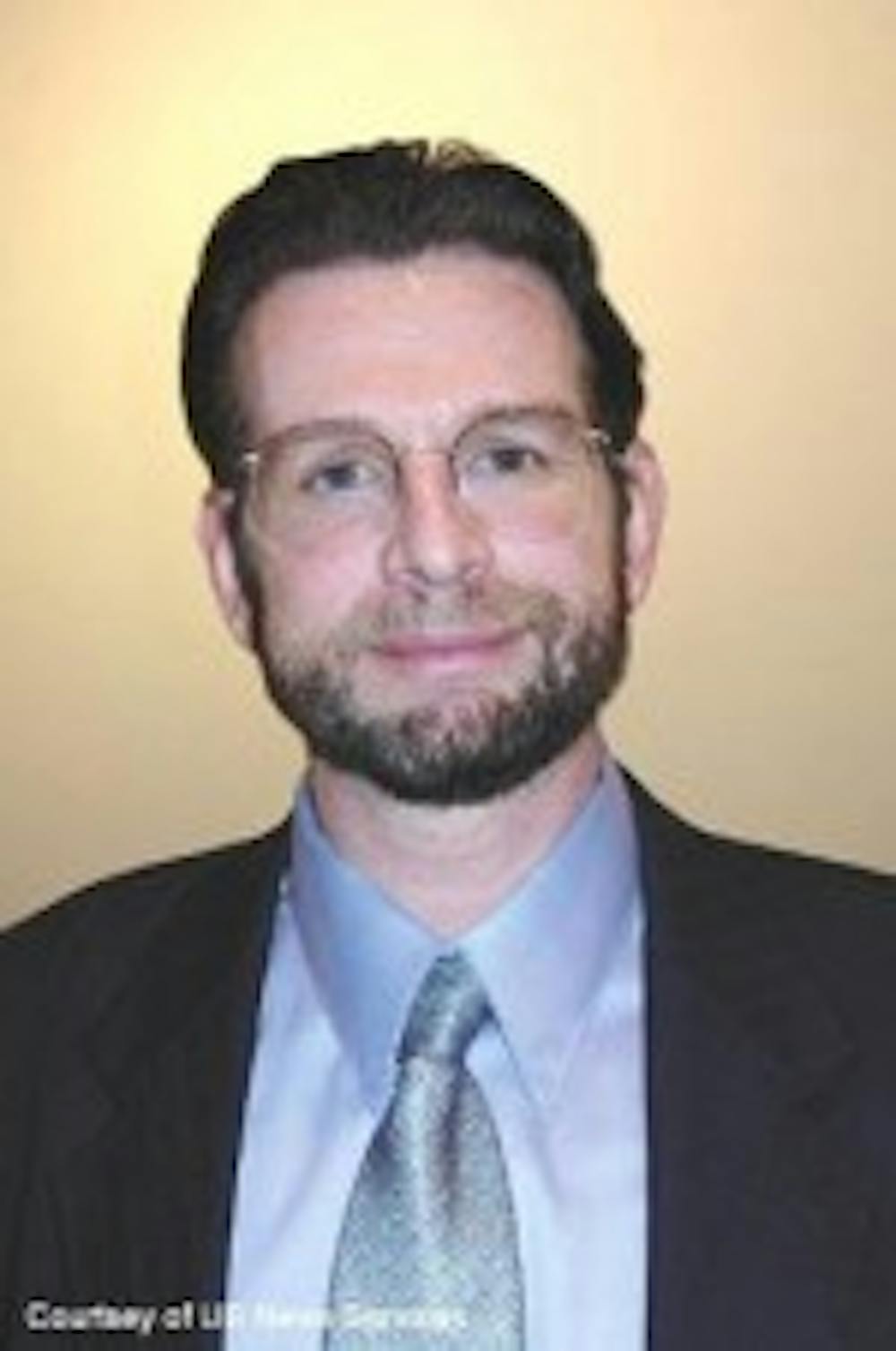
When the much-anticipated Center for Excellence in Bioinformatics opens later this year, it will do so without Jeffrey Skolnick, the prominent scientist who up until last week served as director of UB's new multi-million dollar research hub.
Skolnick's resignation, which became official Jan. 10, ends a three-and-a-half year tenure with UB that some colleagues said was rocky from the start.
Unlike his arrival, which was considered a big score for UB's growing program in bioinformatics, Skolnick's departure to take another job in Georgia has not caused much commotion.
"It's not a surprise," said Bruce Holm, executive director of the center and UB's senior vice-provost. "It's been known Dr. Skolnick has been looking at other opportunities for two to three years now. It's almost as if it were a closure to something everyone expected."
In fact, by the end of his tenure here, Skolnick's role was hardly the same as it was when he was hired. Shortly after President John B. Simpson was chosen to lead UB in 2002, one of his first moves was to reduce Skolnick's administrative responsibilities so the new director could do what he did best: research.
"(Skolnick) went back to being a faculty member without administrative responsibilities, which I thought, and he agreed, was the place he would really do well," Simpson said.
Gov. George Pataki, who proposed the high-tech statewide initiative involving the bioinformatics center's development, dubbed Skolnick a "superstar." Others called him a "rock star" scientist. Either way, both researchers and officials like Holm agreed any such title created a level of hype few scientists could live up to.
"The people who actually used those terms on his arrival, who were not really part of the academic community to begin with, were kind of embarrassed to have done that," Holm said. "People recognized that the expectations and the hype of him coming into town were a bit overblown."
Although Holm said he could not comment on personnel issues, there were also problems concerning Skolnick's ability to get along with his colleagues.
"He was generous, I have to say, in agreeing to speak with the students," said Jane Griffin, a principal research scientist at Hauptman-Woodward Medical Research Institute, one of UB's partners in the center. "Other than that, to tell you the truth, I did not have much in the way of personal interaction, and that was one of his problems."
Griffin said Skolnick was simply not a good administrator and it was telling that he went through three different office assistants in his first 18 months. There was also speculation that Skolnick's push to get his wife a job at UB, along with his $345,000 annual salary, the highest state salary as UB, generated resentment among co-workers.
Ray Dannenhoffer, associate dean in UB's Office of Medical Computing, surmised in The Buffalo News that Skolnick's public quarrel with Dell Computers also played a role in his departure. In 2004 Skolnick criticized the Dell supercomputer technology that powered his research, causing UB to defend Dell, a major partner in the center for bioinformatics.
Having worked on prediction models for protein folding at UB, Skolnick, who could not be reached for comment, will now direct systems-biology research at the Georgia Institute of Technology. Holm called the job "a perfect match for his talents."
In Skolnick's place, Norma Nowak, who had already been serving as a co-director, will take the job of sole director. Nowak was one of the seminal members of the human genome project who has a varied background including cancer research. She has already played a key role developing UB's gnomic bioinformatics teams, leading Holm to call her a well-liked collaborative person.
"She actually on a functional transitional level is the perfect person to be directing that operation," Holm said.
Holm added Nowak also has the necessary appreciation of all the types of technologies the center will be incorporating, from genomic to proteomic and medical informatics.
"She sits at a perfect spot from her background to be able to appreciate the much broader needs that the Center for Excellence has now much more than it did when it started," Holm said.
Looking back on all the hype surrounding Skolnick's arrival, Simpson said he wouldn't have handled the hire the same way if he were in former president William Greiner's position.
"At the end of the day, too, what we have is a faculty member who chose to pursue an opportunity elsewhere," Simpson said. "This happens all the time, and it's not something I pay any interest to."
According to Holm, Skolnick's departure will have little to no impact on the $63 million center, which combines the efforts of UB, Hauptman-Woodward, and the Roswell Park Cancer Institute.
"We have been hiring new faculty, mostly at the junior level, and through UB2020 we have a plan to do additional recruitments, and this does not really look like its going to have much of an impact one way or another," Holm said.
Although some might see Skolnick's departure as a bump in the long road leading up to the bioinformatics center's completion, Simpson said the program's success cannot be measured by the presence of one person.
"The center has already created and retained 4,000 jobs," Simpson said. "It has taken 11 million in research seed funding and turned it into $55 million in competitive grant sponsorship. My view is that it's already quite successful in that regard."
The bioinformatics center will now move forward towards a grand opening in June that will see the program finally in full swing. The next year or two, along with research, will be a time of recruitment, investment, and strengthening relationships with a variety of corporate partnerships.
According to Holm, what the center has accomplished so far, especially concerning grant sponsorship, "in that short a period of time, by all standards is phenomenal."
And as for students getting involved in the program, Simpson said both undergraduates and graduate students can expect curriculums to soon be developed.
"Like anything at universities, it's going to take time to get there," he said.



