
Everybody wants to be Johnny Cash. Musicians from Elvis to Kurt Cobain and Trent Reznor to Nick Cave have made efforts to resemble the Man in Black, in various ways.
Why wouldn't they? Cash was modest, cool, insightful, handsome (but not pretty) and he was a top-of-the-charts entertainer who never sold out.
"Walk the Line" gives a few reasons to reconsider trying to fill his shoes.
The film chronicles Cash's rise to stardom and his time as a rock icon, up to the point that June Carter (Reese Witherspoon of "Legally Blonde") agrees to become June Carter Cash.
It is reported that in preparation for his role as Johnny Cash, Joaquin Phoenix-whom Cash chose to play him when he was alive, based in part on his performance in "Gladiator"-forced himself to develop a drinking problem. Whether or not he had a full-blown addiction, Phoenix does appear weathered. He's less picturesque, less in-shape and has inherited the bags under Cash's eyes.
Phoenix captures Cash's persona in his outward appearance, his mannerisms, and the best surprise of all, the sound of his voice. He looks and sounds like Johnny Cash, not just when he's onstage, not just when he's depressed, not just when he's laughing, but at all these times. He captures Cash as a young man burgeoning with creative energy, as a brash rock star, as a working-class hero and as an alcoholic and drug addict all in a similarly adroit manner.
"Walk the Line" emphasizes the storytelling aspect of Cash's songs, something fans of his music will appreciate. In one of the opening scenes, Cash as a child is told by his older brother Jake, "You can't help nobody if you can't tell 'em stories."
After what seems a brief childhood, tortured by the death of his brother and his ill-tempered father, the film follows Cash into the Air Force. The viewer sees him taking in his surroundings, noting the injustices that provide the context for his dark songwriting.
An effective script allowed for this biopic to remain effective without going overboard with childhood connections. Johnny's father Ray Cash, (Robert Patrick of "Terminator 2: Judgment Day") is a persistently abusive detractor, in the way only a parent can be.
Director James Mangold ("Identity") also captures many subtleties that could have been easily overlooked, and greatly contribute to the film's impact. "Walk the Line" is being marketed as a love story, but it's a rocky one. Mangold doesn't shy away from but calls attention to the dirty, unforgivable things that Cash did to his first wife right alongside the mesmerizing performances and heroic monologues.
He also captures the effect that true-to-life lyrics about relationships can have on an artist's significant other. As Cash sings Dylan's "It Ain't Me" with June Carter, his wife shifts uncomfortably in her seat.
"I'm not the one you want, babe/ I will only let you down," he sings, looking at his wife in the audience. It becomes a self-fulfilling prophecy.
There is no effort to glamorize Cash's life of fame. Conversely, most of the time he spent as a star is portrayed as his worst moments. He becomes an adulterous, pill-popping man who's out of his mind for his tour mate.
Also quietly underscored is the role of God in Cash's life. Cash learned to sing from the hymnals, and lived a relatively quiet life for a rock star. Once he was with the right woman, he walked the line for her.
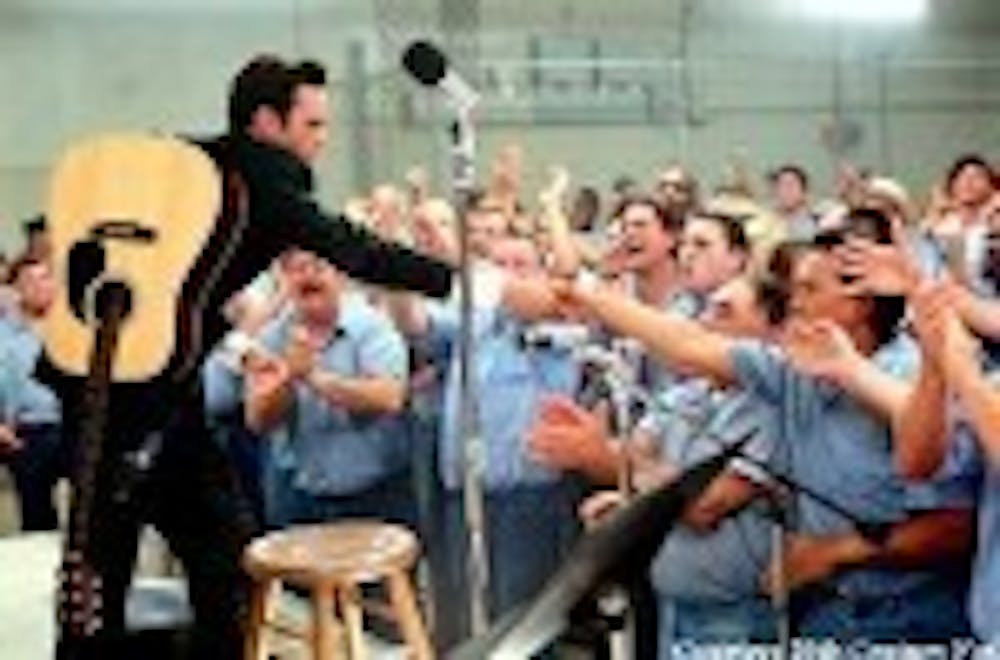
A record executive mentions to him as he is planning his performance at Folsom State Penitentiary that most of his fans are Christians, and won't like him trying to lift the spirits of a bunch of rapists and murderers.
"They ain't Christians, then," he says.
During Cash's depressed episodes, Phoenix gets a bit melodramatic, as the writing seems to demand. This shouldn't necessarily be held against him, as people tend to get a bit melodramatic at times, especially celebrities.
Johnny Cash set the stage for other musicians to bare themselves as emotionally injured people and "Walk the Line" is an unflinching representation of both his sins and his sensation.



