
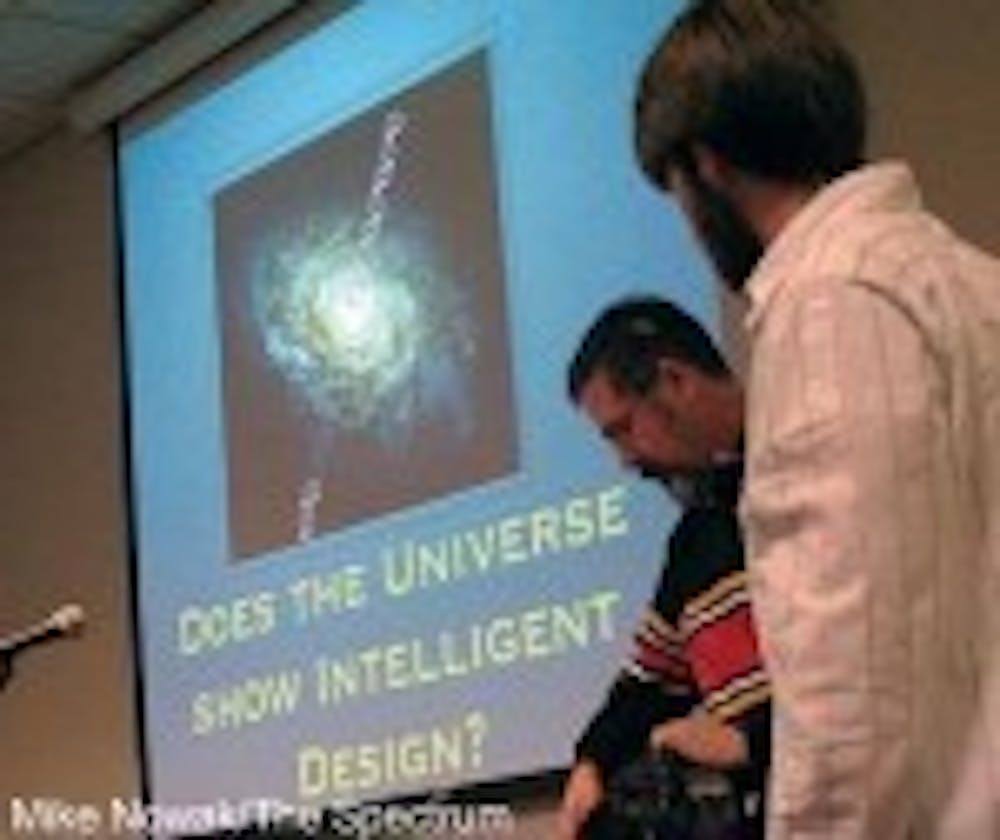
While the national debate on whether to teach intelligent design in science classes rages on, a prominent ID backer made his case for the idea at UB on Thursday.
Kirk Durston, national director of New Scholars Society and Ph.D. candidate from Guelph University, made his argument in a presentation sponsored by UB's Campus Crusade for Christ.
The theory of intelligent design, which is the idea that life is too complex to have evolved through Darwinian evolution, is stirring up controversy not only in high school classrooms but also at universities and scientific research centers.
Durston said his presentation offered a scientific explanation for ID, and said he hopes and expects science to confirm what he already believes: that some unknown creator made all life.
"I have been very interested in the problem of the origin and diversity of life. I'm interested in the details that are always lacking in the creative story telling so common in evolutionary biology," Durston said.
From Durston's point of view, the theory of intelligent design is an up-and-coming theory and would be taught in schools soon after it is clarified and has more evidence.
"At this point, I think it can be mentioned that ID is a current upcoming theory, but I would probably prefer that the actual teaching of ID wait for a few more years until more ID-related papers are published in peer-reviewed science journals," Durston said. "Right now a lot of the groundwork is being published, but we need more than groundwork-we need to follow through with subsequent papers that complete the theory."
But according to Clyde Herreid, a UB distinguished teaching professor in biological sciences, accepting an intelligent design theory is not that easy. He said if there is a problem with the theory of evolution, research conducted has never led to the conclusion that creation is a miracle of a higher power.
"We face problems all of the time in science, but we keep working on the problem. We don't say something is complex in natural selection and therefore call it a miracle. What we do is keep studying the problem and eventually we will be able to explain it," said Herreid.
Some students in attendance said the presentation backed up their belief in intelligent design.
"He brought rational reasons based on solid scientific facts about the world we live in that leaves no space for doubt that the causal factor of biological life and everything there is, is a creator," said Claudio Acevedo, a senior economics major. "It is exponentially irrational to think the characteristics that enabled this world to support biological life were mere coincidence."
Other students strongly disagree with the theory of intelligent design and the proposal that it should be taught in schools.
"How would you even teach intelligent design? 'Class, we're going to learn about intelligent design today. God did it all. Class dismissed,' " said Daniel Colascione, junior computer science major. "Intelligent design belongs in philosophy class, not science, and probably as an example of intellectual dishonesty. If, as a philosopher you want to argue for the supernatural creation of the universe, that's fine. Don't mix that with science, which cannot answer questions like 'why are we here?' "
According to Herreid, a theory of intelligent design would also be very difficult to teach students because of what he said is a constitutional issue of separation of church and state.
"I have not a clue of what to teach if someone asked me to teach about intelligent design except to say that a creator or grand designer did it. It is also against the constitution to talk about the designer in class," Herreid said.



