
"Jarhead" is a war movie without an enemy. Marines are playing football, masturbating, betting on scorpion fights and occasionally shooting at rocks to prepare for the combat they will seemingly never see.
The war film doesn't match the epic battle scenes in "Saving Private Ryan" or "Platoon," but it doesn't have to.
What it lacks in a visual depiction of war is replaced with an adequate storyline and subtle political critiques. The film is placed just prior to the Persian Gulf War.
The structure is similar to the classic "Full Metal Jacket," starting with a malicious drill sergeant abusing Anthony "Swoff" Swofford (Jake Gyllenhaal of "Donnie Darko"). After scenes in boot camp, the action shifts to the battlefields. The troops sing along to "The Cry of the Valkryies" while watching the infamous helicopter attack scene of "Apocalypse Now."
The movie is interrupted by an announcement that Iraq has invaded Kuwait, and the marines are being deployed.
Jake Gyllenhaal performs with surprising competency. Such a pretty-boy does not appear to be cut out for the role of a gruff soldier, but he effectively adapts for the part. Gynllenhaal smoothly transitions from the dramatic scenes to comedy. During a Christmas party, he dances around wearing nothing but a Santa hat, and it's not on his head.
Academy Award-winning director Sam Mendes is best known for the masterpiece "American Beauty." Although "Jarhead" is not on the same level, Mendes' skill behind the camera is still apparent.
When Swoff first arrives at the base, the other marines hold him down and brand him while "Don't Worry, Be Happy" plays in the background. This deliberately offsetting music is much more effective than playing the usual suspenseful soundtrack. Wes Craven is well known for using this technique, particularly in "The Last House on the Left."
Swoff and the rest of the company are in Kuwait as part of Operation Desert Shield. Their mission is to protect the oil fields from being taken over. Some marines voice their beliefs that they are only there to "protect an investment" for bureaucrat oil tycoons.
"F*** politics. We're here now. The rest is bulls***," blurts another soldier.
Screenwriter William Broyles Jr. deftly adapts Anthony Swofford's novel by slipping in snippets of social critiques without being blatant or redundant.
This film was obviously crafted with today's issues in mind, but by displacing the events, the makers skirt the "unpatriotic" label.
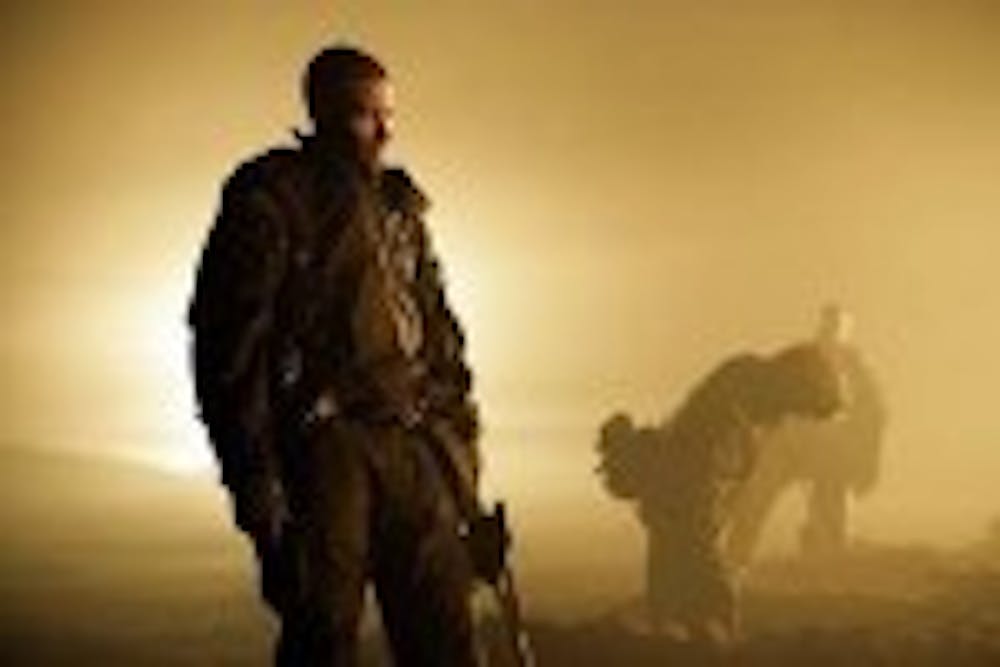
In a particularly striking, politically charged scene, the enemy sets fire to the oil fields. Giant flames rise up and scorch the sky, casting darkness over the area and creating a post-apocalyptic atmosphere. Oil rains down and covers the marines' faces, and gets in Fowler's (Evan Jones of "8 Mile") eyes when he removes his goggles.
These images are clearly symbolic of the fact that these troops are drenched in oil, arguably the cause of the war.
The actors fall short in characterization and the supporting roles are often more flat than three-dimensional. Fowler is the stereotypical insensitive, immature prick who loves to instigate trouble. In one scene, he plays with the body of a dead enemy soldier. The soldiers are bored, and there are so many "crispy critters" out there, he doesn't see the problem with having a little fun with them.
He even offers the other marines a photo op with the smoldering corpse for five dollars.
Troy (Peter Sarsgaard of "Flightplan") is the rational, competent one who later breaks down, not because of all the senseless mayhem and violence, but ironically, because he did not have the opportunity to kill a single person.
This film takes the conventional cinematic shell-shocked soldier and inverts the cause of mania. Here the marines go crazy from boredom. They train hard everyday without seeing any action, and eventually become wired from the tension.
This film works because it relies on story and not the pointless action of battle scenes. After the war ends one soldier declares, "We'll never have to come back here again."
Such wonderful irony should be as mandatory in filmmaking as the script itself. No doubt the filmmakers wanted to take a jab at the current administration, while still remaining true to Swofford's novel.



