
"Be careful, that guy knows Karate."
More than just sounding cool, there are definitely certain advantages to knowing how to defend one's self in a threatening situation. At UB, there are several martial arts styles offered to students who want to learn self-defense, discover a new way to workout or just blow off some steam.
Toran Gordinier, president of the combined martial arts club, encourages everyone to take advantage of the free services offered by his Student Association group. Gordinier, a first-degree black belt in the traditional Korean martial art known as Kuk Sool Won, teaches classes several times a week.
"Kuk Sool Won is really not so much a style as a systematic study of Korean martial arts," Gordinier said. "Korean martial arts tend to be broken down into military-oriented martial arts, non-lethal Buddhist martial arts and individual family martial arts. We sample from all of them."
Many people think that martial arts are just about high kicks and deadly strikes. But Gordinier suggests that practicing a discipline in one form or another isn't just about fighting off masked muggers in a dark alley. More importantly, these ancient Eastern arts are the best defense against many of America's real killers.
"Stroke, diabetes, heart attacks, obesity-all these things are linked to inactivity," Gordinier said. "Practicing martial arts promotes healthy behavior as a way of life and anyone can continue it for their whole life, unlike some other activities."
Studying martial arts also teaches students about the history of Eastern culture, say club members. For example, the traditional styles most people are familiar with today have roots in Japan, Korea and China. But martial arts actually originated in India where Buddhist monks were consistently robbed and, out of necessity, had to figure out methods to protect themselves.
Tae Kwon Do, the most well known Korean art, translates in English to "the art of kicking and punching." Tae Kwon Do presents a different curriculum than Kuk Sool Won, focusing less on throws and joint-locks and more on striking.
"Ideally it's supposed to be 50 percent upper body and 50 percent lower body. It tends to be more kick-oriented," said Sarah Blankenship, president of the Tae Kwon Do club. "However, tournament points are based on any strike, be it with hands or feet."
Competition is a regular part of life in martial arts. Judo is a major sport in Japan, and Karate tournaments are very popular in the U.S. Brazilian Jujitsu and Russian Sambo are lesser-known fighting styles but are rapidly gaining popularity. These arts focus on grappling, like wrestling, as well as submitting opponents with joint-locks and chokes.
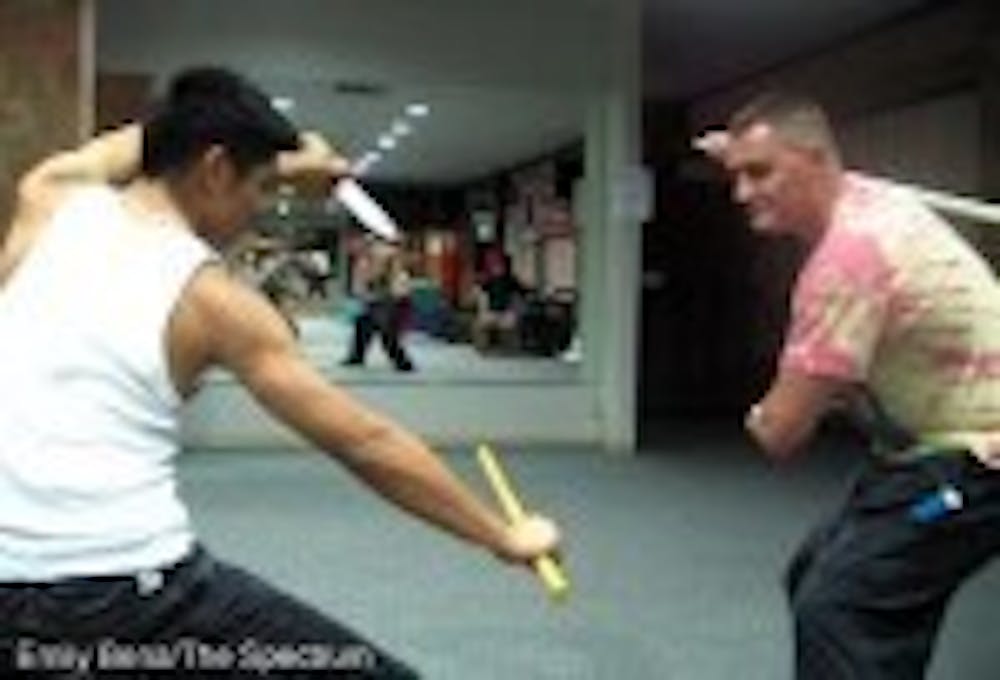
Other styles offer the use of weapons. Kendo is a popular form of Japanese sword fighting, where Samurai-like armor is awarded through rank promotion. Modern Arnis, also known as Filipino Kali, presents fighting tactics through the use of short sticks and knives. Both styles are offered on UB's North Campus.
"A lot of cops take modern Arnis," freshman undecided major and head instructor of the modern Arnis club Scott Caffrey said. "It's really practical in self defense situations because the kali sticks can be replaced by a broken beer bottle, chair legs and anything else lying around."
It is important to know what each martial art has to offer before committing to any style. Not all forms are for everybody. Peter Macaluso, a third-degree black belt, UB alumnus and head instructor of the Seido Karate club, said his preferred style of practice has evolved into a form that welcomes all people.
"It originated as Kyokushinkai Karate which was basically you walk in on your first day and fight full contact whether you know anything or not," Macaluso said. "Such a philosophy didn't suit older or more physically challenged people, so something had to be done."
In order to become more accommodating, Seido Karate was re-evaluated and made to accommodate anyone who had an interest in joining.
"Spirit before technique and technique before strength," Macaluso said. "In all parts of life, there are setbacks, be it physical or mental. What we teach here at Seido Karate is that they can be overcome."



