
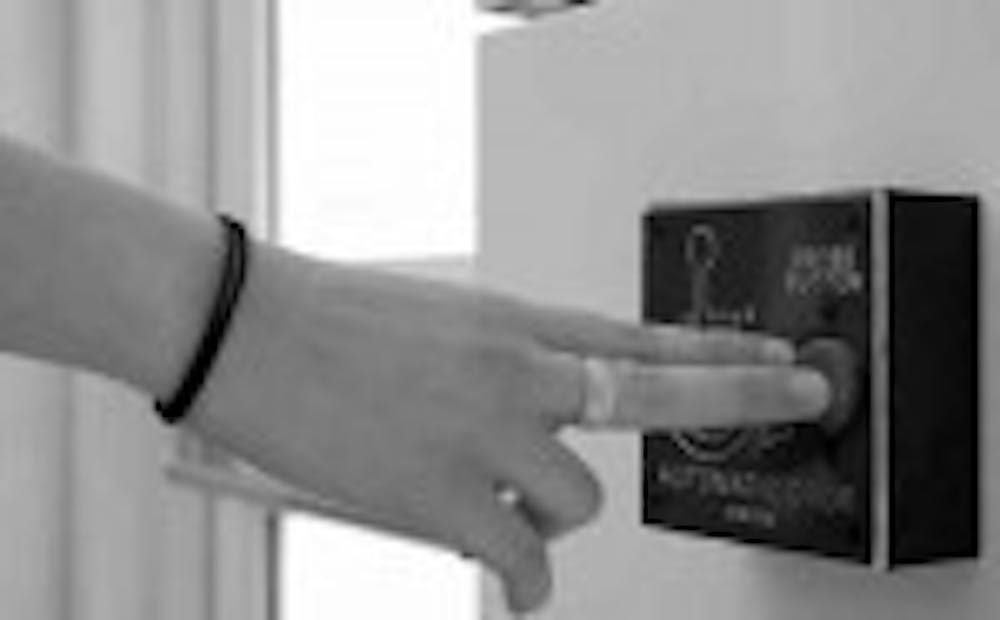
Most students walking to and from classes don't think twice about pushing the blue buttons with "handicapped" insignia that will automatically open the doors to buildings.
Sure, your mom always told you not to do it because you were fortunate to be able to open the door and walk right through it, but according to UB Green officials, needless button-pressing ends up costing UB thousands of dollars in extra energy costs.
"Whenever a person uses a handicapped door button, the doors open automatically and they stay open for a longer time than they would if someone was walking through," said Walter Simpson, an energy officer with UB Green. "If you don't require that service because of a disability, you're wasting energy by leaving the doors open."
The energy is wasted because cold air enters and heat is lost, and the building's heating systems then need to make up for the temperature change and loss of heat. In places like Capen Hall, where the handicapped-access doors are consistently wide open, it's a big deal, Simpson said.
"It's more of an issue in the winter," he said. "At home, you wouldn't normally leave your door open in the winter, but that's essentially what happens when someone that doesn't need those doors uses them."
"I couldn't tell you exactly how much this ends up costing the university," he added, "but it probably amounts to, over the course of a winter, somewhere around a couple of thousand dollars."
Energy wasted when the doors are open in turn can affect the environment in the long run and even cause additional air pollution, considering how often this happens in buildings nationwide.
"The energy and electricity being wasted needs to be compensated with additional energy and electricity use," Simpson said. "This additional energy is generated at power plants which often generate air pollution and waste."
The thought that using handicapped buttons affects energy efficiency doesn't occur to most students.
"I wouldn't think about the heat that gets lost, but sometimes the doors don't open when you hit the button and I think about how that's going to affect people who need that service," said Daniele Hauptman, a sophomore English major. "I wouldn't think about the energy effects, and I don't think anyone thinks about air pollution when they use the buttons."
"In terms of how cold it gets in the Student Union, yeah I've thought about that," said Paul Coir, a junior philosophy major. "It gets pretty cold in here. But in terms financially, I never would have thought of those effects."
Farrah Black, a freshman business administration major, said that the additional costs shouldn't be of concern to the school.
"For me, if I have a lot of stuff in my hands I'll push the button with my elbow. I don't use it because I'm lazy," said Black. "I see a lot of people pushing the buttons near the Elli, to go to the bus, and that's just plain laziness. You'd think the school has enough money to deal with it, though."
According to Simpson, however, the energy loss can have a significant affect on the school's utility bills.
"Most people are not carrying a lot of stuff when they hit those buttons. If they are it's more understandable, but it is something that most people don't think about," he said. "But they should be thinking about this. It's costing the university a significant amount of money for appliances that are being used needlessly."
"We want to save money and reduce environmental impact," he added. "We would make a lot of progress if people would just think about things instea



