
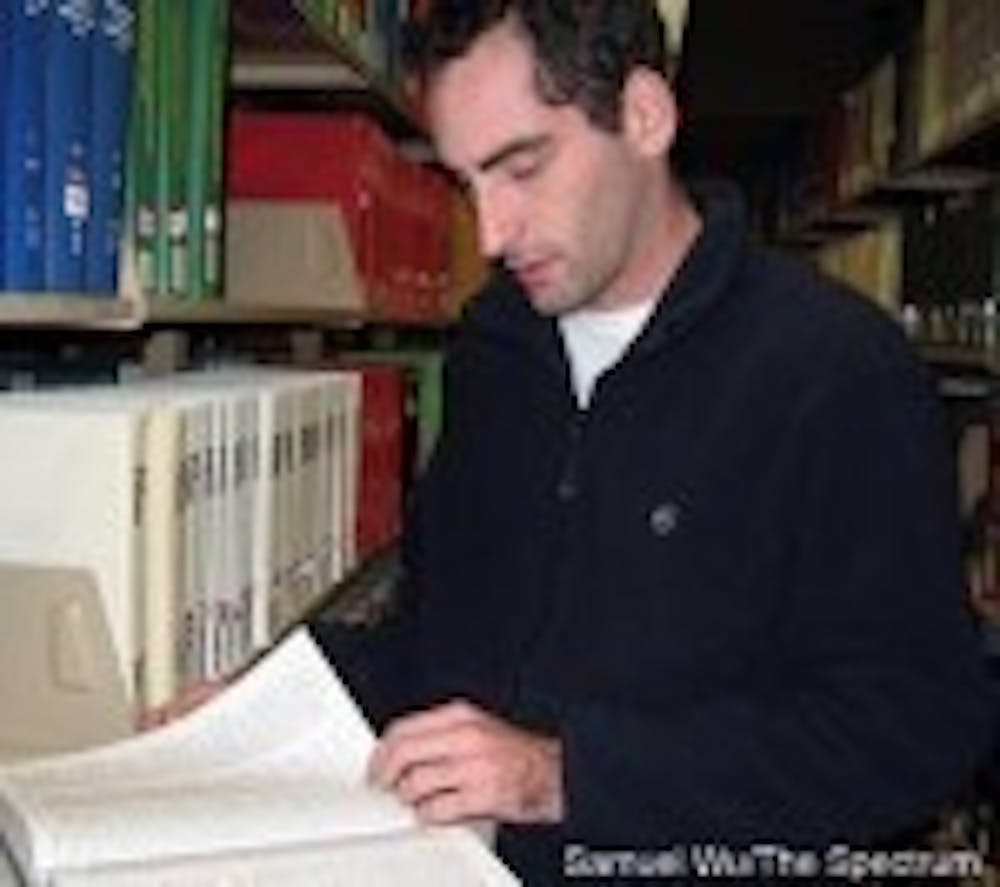
For the average pre-professional student, life is not always a bowl of cherries filled with late night parties and an agenda of different social activities.
In medical schools around the country, only one third of all applicants are accepted. Sixty percent of medical school applicants, considered fully qualified, are rejected. The average minimum GPA required is a 3.6.
At UB, there were roughly 1,700 applicants for the pharmacy program for 120 spots in 2004.
Many would argue correctly that all work and no play makes Jack a dull boy, but for any student looking to get into the professional school of their choice these days, there is a long, expensive, stressful process of applying.
Aside from being faced with the competitive aspect of these pre-professional programs' accepted applicants, these programs also often require extensive schooling, money and time commitments. Students in these programs often do not reap the financial rewards of their field of study, or the satisfaction of the esteemed position, for several years.
Alex SanSouci, a senior psychology major, said that he has spent over $3,000 dollars applying to medical schools so far. He has no guarantee that it will be worth it in the end.
Despite the difficulties pre-professional students face, many students across the United States choose undergraduate programs that will help them be accepted into professional programs. With that said, it takes a special kind of student to take on the rigorous demands of today's medical, law, pharmacy and doctoral graduate programs.
"I told my mom I wanted to be a doctor when I was four, and I never changed from that," SanSouci said. "I just never really wanted to do anything else, nothing else appealed to me."
SanSouci said he is driven to become a doctor because of a doctor's idealized status in society, because when people are at their worst, the doctor is the one to make them better.
"I deal with people a lot, so I like the idea of fixing them," he said. "People come to you with a problem, and you have to fix it-something about that is cool."
SanSouci interned with a cardiologist in high school, solidifying his desire to become a doctor, specifically, electrophysiology cardiology. Over the course of the internship, he watched numerous surgeries.
"I couldn't get enough of it," he said.
In pursuit of becoming a doctor, SanSouci submerged himself in the medical field. He became an intermediate EMT, and a volunteer firefighter in the town of Getzville, working over 30 hours between both positions along with his schoolwork.
SanSouci started out as a biology major at Niagara University but found the core classes such as ecology boring, and opted instead to major in psychology and take his pre-med requisites.
The only fear in SanSouci's mind is having a patient he is not able to fix.
Steve Halady has gone through the process as a first year graduate student in pursuing his doctorate in philosophy, which is a four to five year endeavor. He earned his undergraduate degree from John Carroll University in Cleveland.
"I took some classes as an undergraduate and I decided that is what I enjoy most," he said.
Halady has received a number of scholarships to help him with the cost of school. He admitted that he has had doubts about the time commitment but he says he is no different than other students who may be concerned.
"No more than I think any other student would at any point," he said.
Halady is motivated by the desire to teach and work with students.
"The very nature of philosophy is that you have to be open to other ideas, and critical thinking is a skill that is very valuable to have," he said.
Other students have spent numerous years in school and have yet to enjoy the fruits of their labor.
James Thompson is 31 years old and will not finish with his schooling until 2008. Thompson graduated from LaSalle University in Philadelphia with an undergraduate degree in English and biology, and from Lake Erie College of Osteopathic Medicine in Pennsylvania with his doctorate in radiology. His official title is doctor of osteopathic medicine.
Thompson's total time spent in school will be 14 years. He is currently working on his residency through UB, rotating every few weeks at local hospitals, including Roswell, Children's and Veteran's Hospital.
After his residency is completed, he will spend a year doing a fellowship, further specialized training in the field of radiology. Thompson said he plans on pursuing MRI imaging.
Even though he is a medical doctor, the classes haven't ended. A typical day for him involves listening to a lecture from 7:30 to 8:30 a.m., working until noon, reading film or performing patient biopsies, listening to another lecture on his lunch break from noon until 1 p.m., working until 5 p.m., and if he is on call, staying overnight.
However, although he has a tough schedule and long days, Thompson says that in the end, the hard work and serious time commitment is something he enjoys doing.
"A lot of us know going in that it's life long learning," he said. "Sometimes it can get overwhelming, but its something all of us kind of like to a certain extent."



