
Most people envision a suicide bomber as a cackling schizoid maniac with nothing to lose, strapped head to toe with dynamite.
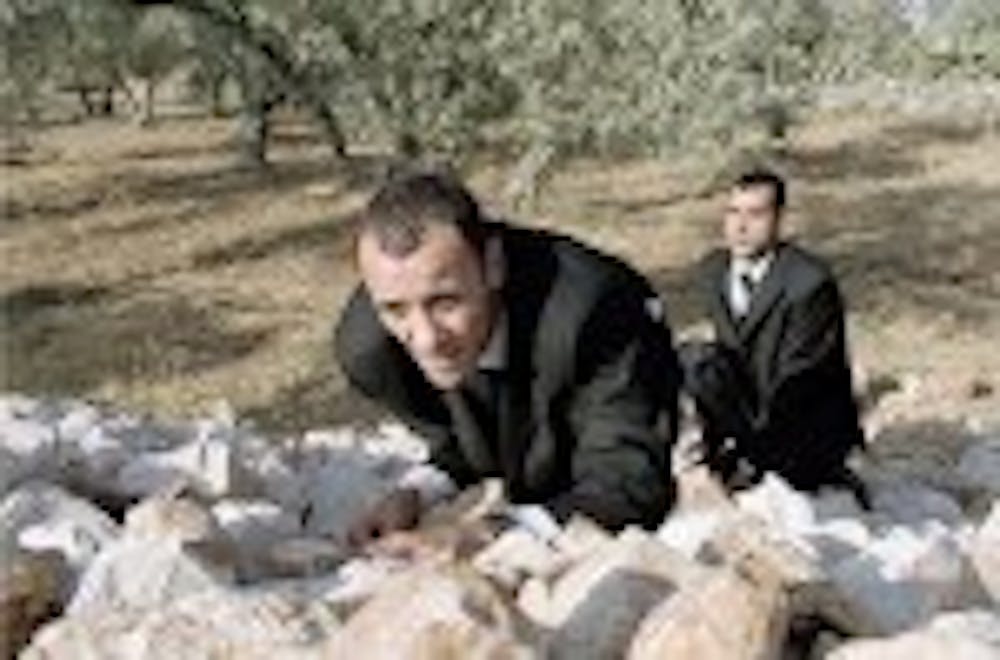
Best friends Said and Khaled hardly fit the profile of the stereotypical Palestinian suicide bombers in "Paradise Now," a film directed by Hany Abu-Assad.
Said repairs cars, living with his mother and younger siblings. Oppression chokes their land and their people, and the arrival of Israeli settlers has only added to the misery.
Netherlands-based Palestinian film director Abu-Assad ("Rana's Wedding") is virtually unheard of in the United States. However, after the controversy that "Paradise Now" is sure to spark, Abu-Assad should expect international recognition.
His camerawork accurately showcases the impoverished Palestinian environment. Shooting on location immensely adds to the realism of the streets and dwellings.
In one scene, a young child working as a waiter brings Said and Khaled drinks. The boy only receives a coin for a tip, and stares at Said as if trying to entrance him into charity. When the two cross the border, Israel is portrayed as a verdant, thriving country with tall skyscrapers, shiny cars and palm trees resembling a resort in Florida.
Both Kais Nashef and Ali Suliman make their screen-acting debuts as Said and Khaled, respectively. For novices, they are proficient at humanizing the characters without evoking an overt amount of sympathy.
Said is seen at home playing with his younger brother and visiting with his family. When he is called to duty, he has some reservations about going through with the attack.
In one truly humanizing moment, Said is about to board a bus full of Israeli travelers. When he sees a child talking to the driver, he halts the attack.
The film's controversial messages are often conveyed through the dialogue between characters.
In one, Jamal (Amer Hlehel) justifies the attacks to Said. He criticizes the concept of "the strong devouring the weak," claiming that it brings people down to the level of animals. When it comes down to it, they must do whatever is possible to defend their freedom.
Said's girlfriend Suha (Lubna Azabal) represents a more worldly view because she has been living in other countries and just recently returned to Palestine. According to Suha, suicide bombings give Israel an alibi. Israel is the true oppressor but the bombings allow them to claim to be the victim, she says.
Said counters this by asserting that if the enemy is playing the part of attacker and victim, Palestine must fight fire with fire, and act as both victim and murderer.
This film places less responsibility on the actual bombers, while evoking more sympathy for their families and placing blame on the forces that compel the bombers.
Said and Khaled are indecisive and always change their view of the right course of action. Everybody wants to solve conflicts peacefully, but sometimes there is no other option than force.
As Said indicates, if the Palestinians could afford planes and bombs, they wouldn't need suicide bombers. Kamikazes are the poor man's defense.
Some will probably think this film is controversial or even detrimental to the current conflicts in the Middle East. The film does forgo mentioning the years of religious conflict that fuel the clash. The problems are so deeply rooted within the people that resolution will require a massive paradigm shift in the thinking on both sides.



