
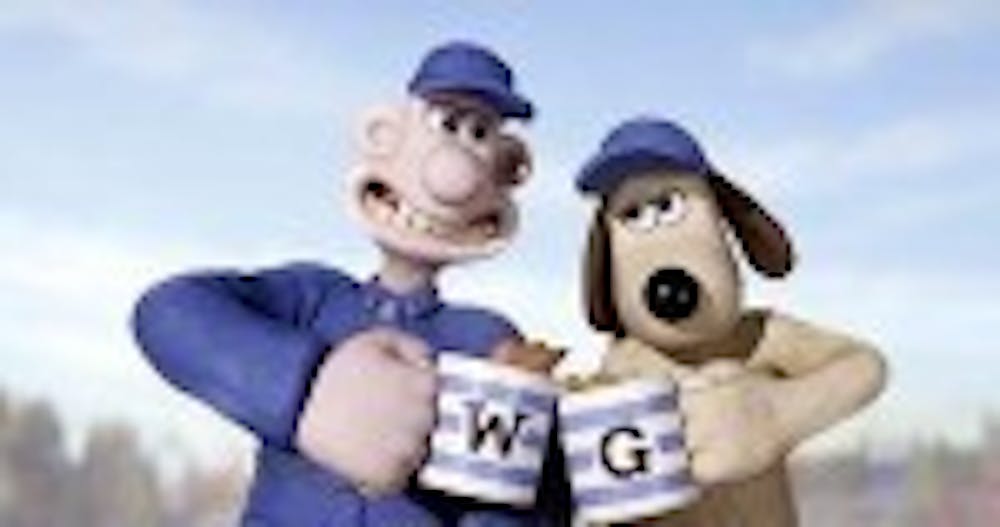
New-age animated films have the unusual ability to appeal to audiences of any age. "Shrek," "Chicken Run" and "Finding Nemo" are all films that had the strange capacity to equally entertain parents, kids, teenagers and college students.
"Wallace and Gromit: The Curse of the Were-Rabbit" follows suit.
The film is the fourth installment of the "Wallace and Gromit" series, but is the first to be a full-length motion picture.
The story follows the cheese-loving technophile Wallace (Peter Sallis) and his more reasonable partner Gromit the dog as they try to protect the town vegetables from pesky rabbits in the days leading up to the 500th annual Giant Vegetable competition.
It's packed with goofy humor for children, along with a few subtle jokes and references to keep older viewers smiling.
Directors Steve Box and Nick Park have a real knack for animated humor. They put an emphasis on the slapstick cartoon situations and used dialogue conservatively to explain necessary plot points. Wallace's bookshelf, for instance, contains "Swiss Cheese Family Robinson" and "Grated Expectations."
There is also a wacky invention that takes Wallace from his bed, gets him dressed and fed and dropped into his car automatically. Box and Park fully utilize the unlimited possibilities of animation with imaginative visuals that could tell the story by themselves.
Box and Park are responsible for the 2000 release of the stylistically and aesthetically similar "Chicken Run." Park has directed all the previous "Wallace and Gromit" films while Box made his directing debut with this installment.
Mixing in references to popular culture softens the social commentary. When Wallace decides to test his new mind control machine on the rabbits, Wallace says that "a little brain washing never hurt anyone," over foreboding music while Gromit cringes at the thought.
There is a nice blend of light and dark material that gives the film tension at parts and outright goofiness at others. It's not as dreary as "The Nightmare Before Christmas" but has its darker moments.
The moral messages continue when Victor Quartermaine, voiced by Ralph Fiennes ("The English Patient," "The Constant Gardener") is introduced. He is the snide, gun-toting hunter who thinks any problem can be solved by shooting it. Lady Tottington (Helena Bonham Carter of "Fight Club" and "Corpse Bride") opposes this, insisting the rabbits should be dealt with in a "humane" way.
Members of PETA will adore this film.
Not all the jokes are so pointed. Most of the film is more low-key. In one scene the town preacher is growing veggies for the competition. He is heard praying, "and the weak shall become the strong, and the small shall be the great."
It is then revealed that he is praying over a giant eggplant, which he proceeds to sprinkle with holy water.
The film is filled with references to other movies, a common tactic in animated movies. The scene where Wallace indoctrinates the rabbits is a nice tribute to "A Clockwork Orange." The rabbits appear catatonic after the treatment, standing in place and shaking profusely.
When Art Garfunkle's "Bright Eyes" comes on the radio, which was featured on the film "Watership Down"-an animated film about rabbits searching for shelter, Wallace immediately switches it off.
The gate lifts when their vehicle leaves, making reference to Batman. The giant rabbit scaling a building with Lady Tottington under one arm is an obvious reference to King Kong. There are far too many to list, and multiple viewings may be required to catch them all.
Films like this are not for everyone. Children will probably love it, and adults with a sense of humor should be able to at least tolerate it. Not every joke hits the mark, but the movie is funny often enough to gain merit. Wallace and Gromit have an original flair, and their unique humor prevails.



