
Imagine living in a country where you were not free. In hopes of a better life, you leave all you have ever known behind -- career, family and home -- and travel across sea to a completely foreign land, where the language and customs are drastically different, and where there is no guarantee you will find success in starting a new life. Your possessions are the bare minimum. Until the new country accepts your paperwork, you are a refugee, and completely dependent on the generosity of complete strangers for survival.
At Vive La Casa in Buffalo, the largest refugee shelter on the northern border, volunteers dedicate their time and money to help individuals from around the world. Surprising numbers of Buffalonians aren't even aware of its existence.
Vive was founded in 1984 in response to an increasing need for incoming refugees looking for a place to go, as they cannot work to provide for themselves until their new country has recognized them.
It is an interfaith, non-profit organization that assists refugees seeking protection in Canada or the United States under the Geneva Convention that is funded by some government subsidies and grants, but mostly donations from individuals and religious organizations.
The shelter began in a modest sized home in Lackawanna, but soon moved to the former St. Matthew's elementary school in 1991.
"We provide safe shelter, food, legal services, and any kind of medical care they need," said Sister Alice Gilabert, who has been working at Vive for the past three years as the volunteer coordinator.
Most refugees stay for two to three weeks, while others are considered long term residents and are forced to stay for six months or more while waiting for political asylum in the US or Canada. Waiting for political asylum can become a long tedious process due to language barriers, high demand, and the need for written documentation that the refugee was persecuted in their former country.
When Vive first opened it only sheltered Central American refugees, but now provides refuge for individuals from all over the world, over 90 countries, who have fled their countries because of their race, nationality, religion, political opinion or social group.
"We try to provide for as many needs as we can," said Sister Louise Lopez, who has been with Vive for over 15 years doing everything from housekeeping to answering phones in fluent Spanish. She became involved with Vive when the Catholic school she was teaching at closed down and she lost her job.
"I feel enriched by all of these cultures, all these years," she said. "People know if you love and care for them, and you don't even have to say a word. No culture would reject a hug and a friendly hand."
Residents receive three meals a day, clothing, toiletries and laundry soap, among other daily necessities. Living at Vive isn't a piece of cake, because each day is filled with anxiety about what the next will hold.
One Thursday last week the building was buzzing with people. Walking into Vive, it feels as if one has stepped into another country.
The children that were not in school ran around playing with each other, and in the community room, volunteers put together the seasonal newsletter. At noon, the residents filed down to the basement, to the cafeteria for a warm meal. In the basement are the bathrooms and shower areas, a game room filled with donated pool tables, and a teen room out of which came a range of music genres, much like its inhabitants.
On the second floor are the dormitories, male and female, where residents stay in large, bunk bed filled rooms. There are inside and outside play areas for the children, which volunteers help supervise.
As the shelter is a former school, cement floors are throughout. Colorful murals and pictures with messages in several different languages, left by volunteers and past residents, adorn some of the walls.
As the shelter is a former school, cement floors are throughout. Colorful murals and pictures with messages in several different languages, left by volunteers and past residents, adorn some of the walls.
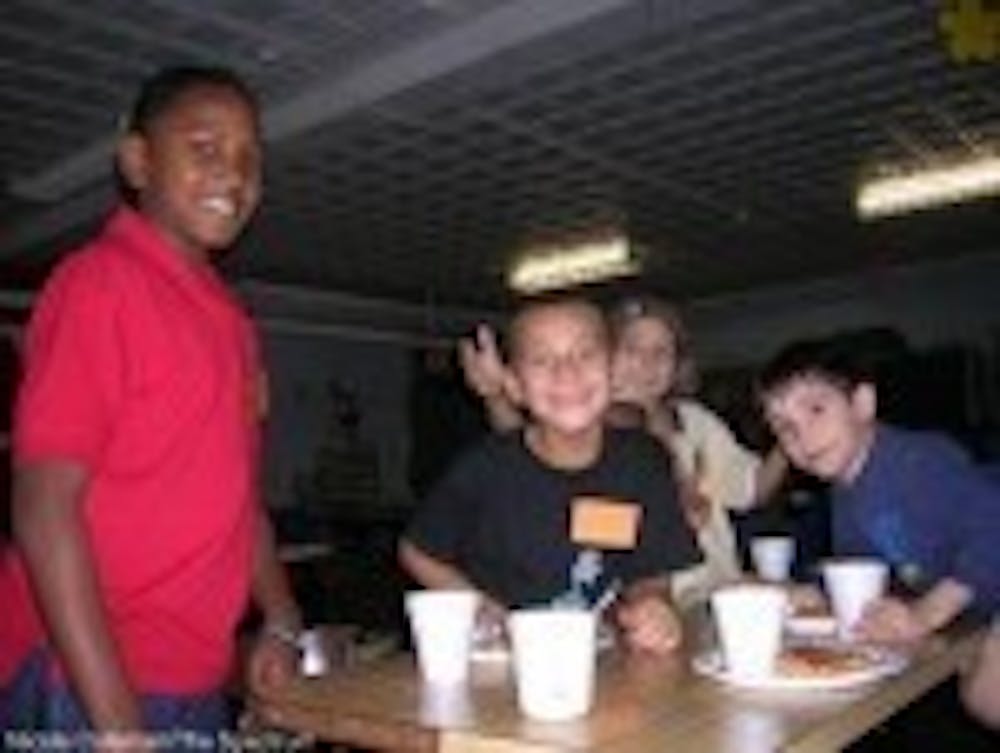
In the afternoon, the UB South Asian Fraternity, Iota Nu Delta, brought pizza for the children and residents, a regular monthly occurrence.
"We kind of adopted them for the next four or five years," said Samir Nayyar, a senior biomedical major. "Something as little as pizza goes so far. We try to welcome these people."
Vive houses 118 residents, and they have been at capacity for the past two months, partly due to the Safe Third Country agreement implemented by the US and Canada Dec. 29, 2004.
"We have to turn people away right now," said Sister Alice. New refugees are sent to nearby hotels.
In the weeks leading up to Dec. 29, almost 1,200 people were processed, 900 in one week alone, as volunteers rushed to get as many refugees registered as they could. Since Vive's inception, over 53,000 refugees have been aided, sheltering over 300 refugees a month. Over 4,300 refugees were aided in the year 2004 alone.
"I found it really striking to see how kids from different parts of the world play and get along, and how they walk up to you as if they knew you from the start," said Brian Menezes, an international student from Kuwait, and a junior communications major. He has visited Vive twice, painting and caulking bunk beds, and organizing a storage room.
"I could see my own people among the people from other countries on the other side of the wall. It makes me feel so privileged to be studying in the US, and to enjoy and the freedom and benefits of a better life," Menezes said. "They leave everything behind, everything that they love and cherish the most, in a search for a better life.



