
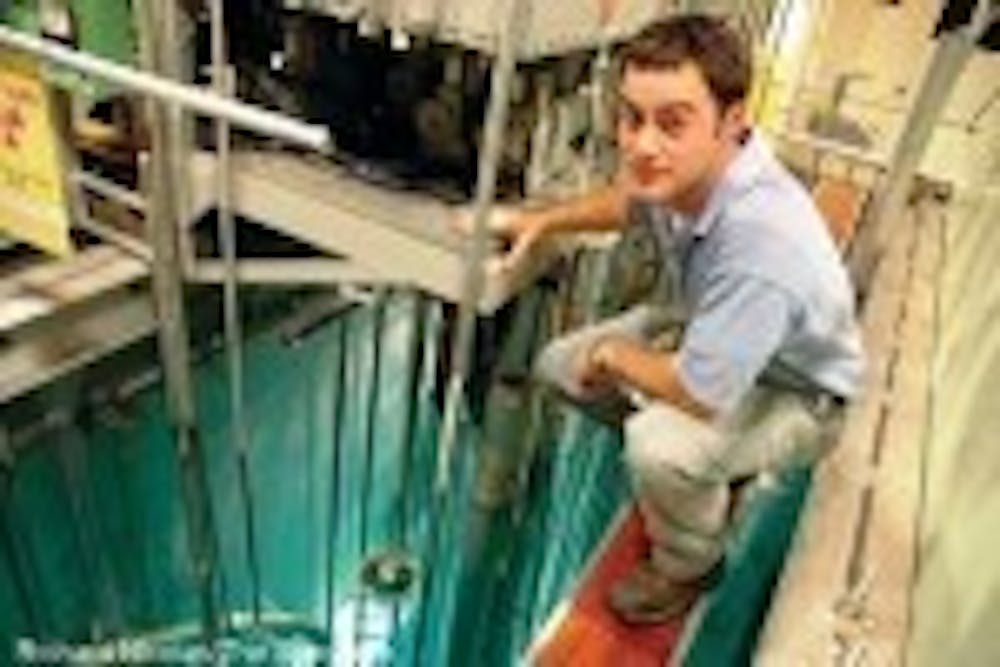
Amid heightened awareness for security surrounding nuclear reactors at U.S. universities, UB has successfully removed spent fuel from its own nuclear reactor on South Campus.
The removal of the fuel from the Buffalo Materials Research Center was carried out during the week of Sept. 19 in a joint effort between a licensed contractor, UB officials and technicians, and the U.S. Department of Energy.
The nuclear material, which had been stored in an on-campus containment center, has since been transported to a government-operated facility in Idaho. Details about the removal and transport could not be released until ten days after its completion because of a federal mandate over national security.
The BMRC reactor had a 34-year lifespan, and ceased operation in June 1994. While operational, the reactor was used for medical and commercial research. The removal of the spent fuel was a beginning step in officially decommissioning the research reactor in accordance with Nuclear Regulatory Commission.
"The facility is now in a benign condition and all materials are secured," said David Vasbinder, facility director of the BMRC. "However, it is still licensed by the Nuclear Regulatory Commission and thus will be required to be decommissioned as per regulations of the NRC."
In the same week as the announcement of the fuel removal from the BMRC, an investigative unit of ABC News released results of a four-month investigation of the security levels at 25 university research reactors across the United States. UB was not one of the facilities featured on the program.
The ABC News study sent journalism graduate students undercover onto university campuses to see what lapses in security they could find, including accessibility to hazardous materials and the proximity to public roadways to reactors, which the investigation considers a risk for a truck bomb.
According to the written report on the ABC News Web site, out of the 25 schools visited, "none of the college reactors had metal detectors, and only two appear to have armed guards. Many of the schools permit vehicles in close proximity to the reactor buildings without inspection for explosives."
Among the findings were also unmanned guard booths, a guard who appeared to be asleep, unlocked building doors and, in a number of cases, guided tours that provided easy access to control rooms and reactor pools that hold radioactive fuel.
In response to the report, Vasbinder said, "Security at such on-campus facilities is entirely based on the actual risk a particular facility presents and not based on someone's perceived risk or opinion."
The UB facility meets a security plan approved by the NRC and the Federal Department of Homeland Security.
"It is important to note that the level of security required at such facilities is based on the determination of the actual risk that a specific facility presents and is therefore not the same for all such campus-based facilities," Vasbinder said.
The recent fuel removal from the BMRC was done under approved plans from both the NRC and the Department of Homeland Security.
"We still are operating under a Nuclear Regulatory Commission-approved security plan and therefore we can not discuss any specifics of the actual security arrangements," Vasbinder said. "However, during the entire time that the fuel removal activities were taking place on site, there was a live, physically present, security force. Security for the fuel shipping process was a combination of local law enforcement and state and federal authorities as per the federal requirements."
Since the release of the ABC News investigation, the NRC has sent letters to the facilities featured on the program, and thanked ABC News for sharing the results of their study. ABC News reported that it shared its findings with the NRC and the involved universities before airing their report so that security lapses could be addressed before being shared publicly.
NRC officials said after the study that facilities that are potentially more attractive to terrorists have more security measures in place. Research and test reactors pose a low risk to public health and safety, officials added.
The BMRC facility will now continue the process of being decommissioned, in accordance with NRC regulations. The process is not expected to be complete for several more years.



