
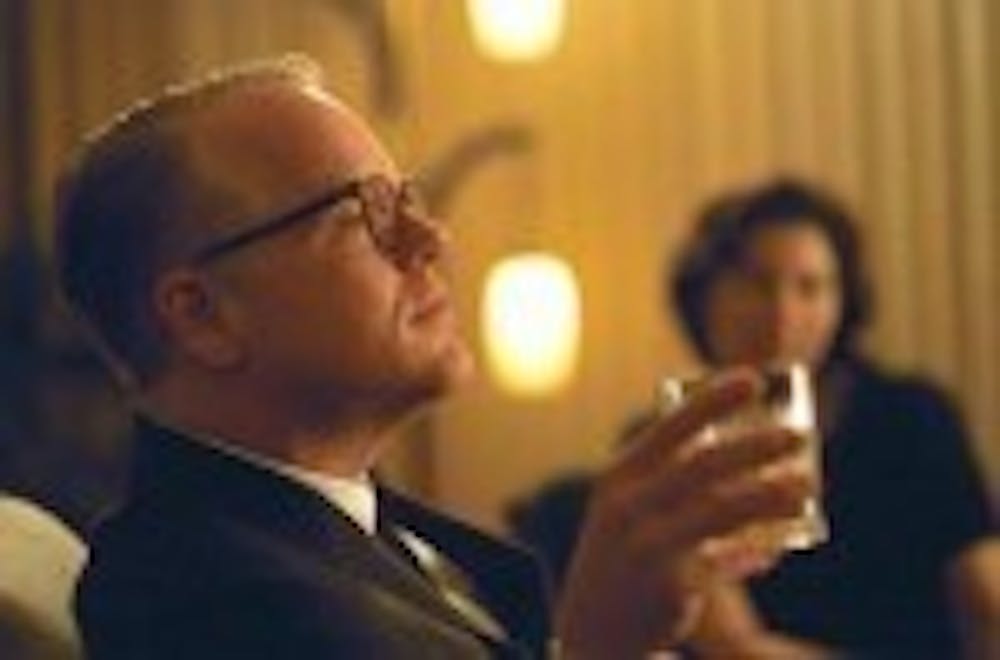
"Capote" is one of the frontrunners for Oscar glory this year. While it is a standout flick, some of its faults need to be addressed before jumping on the Capote bandwagon.
The movie, a screen adaptation of Gerald Clarke's "Capote: A Biography," focuses on screenwriter Truman Capote's journey in creating the famous novel "In Cold Blood."
Philip Seymour Hoffman takes on the lead role with authenticity and gusto. It is difficult for an actor to portray someone of recent fame, with the subject's personality still fresh in the viewer's minds.
However, Hoffman perfectly captures the queerish, self-absorbed man-boy demeanor of writer Truman Capote. He has played a series of strong supporting roles in hits like "Magnolia," "25th Hour" and "Red Dragon," but this performance stands out.
Capote is far from the dorky reject that his meek mannerisms make him out to be. He is the life of every cocktail party, always discussing his experiences and literary works.
When he sees a newspaper article about a family recently murdered in their Kansas farmhouse he becomes infatuated and decides to dramatize the events in a novel.
The film is an examination of the mind and motives of a killer. Perry Smith (Clifton Collins Jr.), the accused murderer, develops a relationship with the writer.
During a trip to the supermarket to buy some baby food for the self-starving inmate, Capote sees a creepy child leering at him. The boy draws a fake pistol and points it at Capote while glaring menacingly. This situation begs a question: when do innocent children turn into killers?
As the story develops, Capote and Smith get closer and realize that they have many similarities. Smith emphasizes his need to be held in high esteem, a quality also sought by Capote, who must constantly entertain people with witticisms in order to be liked.
He is so concerned about this that he pays a baggage handler on a train to praise his work in front of Nelle (Catherine Keener), a longtime friend.
Although the film is inherently slow, director Bennett Miller helps speed up the action through editing. Rather than waste time with travel between places, the scenes cut rapidly from outside to inside, restaurants to prison, and even the immediate teleportation overseas when Capote travels to Spain to work on the novel.
Miller also uses a cinematographic style that creates a documentary feel. Most shots are static or handheld, providing a personal, intimate atmosphere. There are hardly any long, sweeping tracking or establishing shots. Miller's only other work is "The Cruise," a documentary about a tour guide on Manhattan's Gray Line double-decker buses.
There is little conflict and tension in this film. Where there is, the feeling is derived from the race-against-the-clock scenario as Capote tries to elicit the details of the murder from Smith before his execution date.
Without the information, Capote has no ending for his novel. As Capote and Smith become friends, he grows less concerned with the novel and worries more about finding a lawyer to get Smith an appeal and another trial.
"It's like Perry and I grew up in the same house. Then one day he got up and went out the back door, and I went out the front door," Capote says.
Apparently a thin line lies between the actions of a killer and the rest of society. In the novel, Capote makes a distinction between two worlds: the world of the killer, and another quiet existence populated by the rest of society. When the two worlds collide, bloodshed ensues.
Many viewers will probably find "Capote" boring. It's good by art film standards, but lacks the intensity that most viewers desire. Being drawn into a documentary is very hard, and connecting with this film on many levels is difficult. The film is well written, acted and directed, but when it all comes together it leaves the viewer wanting more.



