
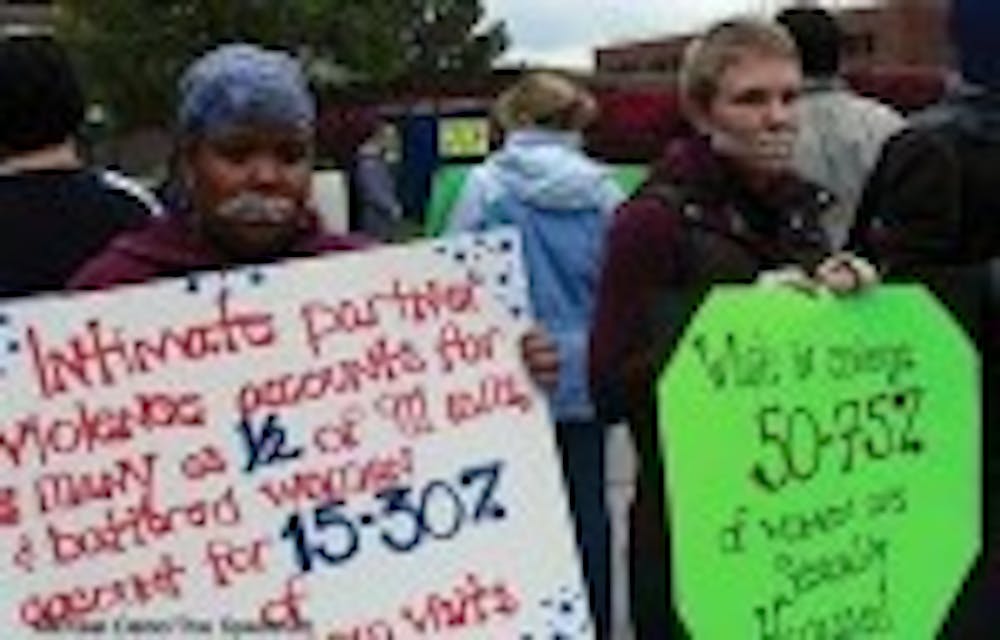
When the University of Maryland recently awarded its students the freedom to hand out fliers, protest and speak on campus, its students gained rights UB students had already been enjoying for years.
"This campus has been the home of regular demonstrations, many involving issues to which our campus is not a party," said Dennis Black, UB vice president for student affairs. "The rules are pretty simple: we're a public, open campus, and you're welcome to espouse your views as long as you are not disrupting our academic mission. We're a marketplace of ideas."
Although UB does little to limit free speech on campus and students have a near carte blanche to express themselves, few students take advantage of those rights, even earning UB a reputation as a politically dead campus in some people's eyes.
Unlike a campus like Maryland's, which still restricts free speech to campus outsiders under a September court ruling, UB officials say they allow almost any activity as long as they remain non-violent, don't disrupt the campus business and don't threaten any people or property.
While UB may be a veritable open forum, it's usually not evident through any visible type of activism. Last week, when there was a Colin Powell protest, a women's rights demonstration and a Bush bash within two days of each other, it was a step away from the campus norm.
With so many outlets and opportunities for students to voice their views, it begs the question why more students don't getting involved.
"You need to remember that demonstrations and picketing are only public manifestations of a group's campaign," said Colin O'Malley, a senior member of UB Students Against Sweatshops, an activist group on campus that has been highly vocal the past two years. "They draw the media in and get attention drawn to the cause."
Just because you don't see these activities happening on campus, O'Malley insists, that doesn't mean students are completely disconnected.
"Students are getting involved in groups that are at least marginally political," he said. "The problem is that a lot of the activism on campus is discussion-based rather than change- or action-based. It's a different kind of activism."
Though some students get involved, activist groups on campus are often frustrated by the lack of student interest they run into.
"There are a lot of people at UB that are very strong in what they believe in, but those people are few and far between," said Eileen Marutiak, a senior Spanish and communication major who works with Planned Parenthood. "It's frustrating that we've got such a large school and so little interest from the students."
Members of the few outspoken campus groups say the indifference they meet can even be bewildering at times.
"I take my activism very personally because the policies that are being made today are put into action by the generation that came before us, but they'll affect our generation and generations for years to come," Marutiak said. "And that's why I feel the need to make sure my voice is being heard. Maybe it's because UB is a commuter campus, but I don't understand why we don't see more students getting involved."
A number of groups like his own and PODER Latinos Unidos have lately been doing less publicity work and more collaboration, according to O'Malley.
"The real campaigns involve education, contacting the administration and base-building meetings with other groups with common interests, as well as meetings with community leaders," O'Malley said. "As part of UBSAS I go to a lot of other groups' meetings to get them involved, and you can get a lot more people involved by doing this."
Keturah Erhardt, sophomore who also works with Planned Parenthood, believes the general apathy could also come from the fact that the current student generation never had to fight for the rights that they enjoy on a daily basis.
"The women of our generation grew up always having access to basic things like birth control or an abortion, or even information about those services," said Erhardt. "Then you talk to our mothers who had a friend die from a botched back-street abortion or who didn't know anything about safe contraception, and we don't have that perspective."
"A lot of people just take these rights for granted," Marutiak added.
Campus activists say another obstacle is that many students choose not to pay attention to events in the world around them, voluntarily disconnecting themselves.
"People just aren't aware or don't want to be," Marutiak said.
"It's easier for students to think 'All I have to do today is my biology report,' not 'I have to do A, B and C, and maintain my human rights,' " Erhardt said.
And while it's easy for activist groups to come up with reasons why people don't get involved, it's harder to come up with effective ways to catch people's attention and call them to action, says O'Malley.
"I think a lot of the institutions on campus tell the students they're apathetic and ask why they're so apathetic without publicizing the means for them to get involved," O'Malley said.
"If you blame them for being apathetic, you're just throwing blame around," he added. "That's not the real issue here."
O'Malley also said he doesn't necessarily think campus activism is as bad people say it is.
"A lot of people look back on the groups in the '60s and '70s and think of those as the glory years for activism, but if you look at the actual group membership, we've got more people involved today."
The real issue is that students need to be more aware of events that are going to affect them for years to come, rather than succumbing to tunnel-vision and focusing on the homework that's due next week, Erhardt said.
"Read the newspaper," Erhardt said. "Just know what's going on, because if you know what's going on, you'll want to get involved."
And today it's easier than it's ever been with the Internet, Marutiak said.
"It's so simple. Just one click of a button and you're making your voice heard. There are little things too. Like, just make the effort to get registered to vote. I hear so many students complaining about things like scandal and fiscal irresponsibility within our own SA, but they're not voting in the elections," she said. "Students need to act locally but think globally, because that's where you start. You start at home."



