
Polite, reserved and well spoken, Peter Rizzo speaks softly, but his words land with a heavy thud.
One of four UB delegates to the statewide student assembly known as SUNY SA, Rizzo is not shy about the organization he was elected to take part in.
"In my opinion it's an absolute joke," Rizzo said, reflecting on the first SUNY SA meeting he went to this summer. "It's a waste of time, it's a waste of money."
To explain, Rizzo cites his efforts this summer on the executive committee, where he is UB's only representative. At the first meeting in June, the committee voiced a need for a new Web site, but when Rizzo chose to lead the project, no one volunteered to pitch in.
Three months later, after extensive work on the Web site, Rizzo said he presented it to the committee, only to be met by bickering and complaints from the people who had never lent a hand in the first place.
"All summer, all the work that had been done on this particular project is flushed down the toilet and we're back to square one on the Web site," he said. "And that's how everything goes, everything they try to do. There's too much bureaucracy."
Another semester, another year of obscurity for SUNY SA. Although it's the only body giving students representation to SUNY and the state government, few students know what it is. And as Rizzo points out, there's good reason why: SUNY SA rarely gets anything done, and the average student never feels its impact.
As a result, Rizzo says UB's delegates are redefining what it means to be a delegate from Buffalo, focusing less on state politics and more on local issues, while still working hard at SUNY SA. And though he says he is one of the few who wants to reform the ineffective organization, Rizzo is finding he's not alone.
A wrong turn
While being the first to criticize SUNY SA for its incompetence, Rizzo is also the first to point out its positives.
For one, the basic structure for what could be a beneficial organization is already in place, even if it doesn't work as is. Two, because of that foundation, if a controversial issue like tuition ever surfaces, there is a group of students ready to respond.
Three, this year he says the executive board is finally looking like what it needs to be. And that is where he is finding his allies for reform.
"As far as the E-board goes, I have a lot of respect for them," Rizzo said. "I think they've taken on quite an undertaking to get this entire organization to perform as a whole for the betterment of the 64 SUNY schools."
Unlike the entire assembly, which includes 112 students and meets once a semester, Rizzo and the nearly 30 person executive committee meet regularly. Within the committee is the E-board and SUNY SA President Josh Hyman, a senior from Geneseo and the lone student on the SUNY Board of Trustees.
When it comes to the rest of the committee, Rizzo says it's like babysitting for children. They always come up with expansive ideas, but few are practical.
"They don't see this organization as non-functioning, they think it's fantastic," he said.
In Hyman, Rizzo says he sees an easygoing, straight arrow leader, and Hyman agrees with Rizzo that SUNY SA has lost its purpose.
"It was created to give students voice in state politics, but it took a wrong turn somewhere," Hyman said.
Rather, it became an organization where students come to pad their r?(c)sum?(c)s and pat each other on the back, Hyman said.
"There's sort of this small civil war going on in the executive committee. It's not that drastic, but it's real," Hyman said. "There's the old school, that really feels strongly that this position should be about privilege, and coming together and feeling good about yourself and talking and blah, blah, blah and nothing that amounts to anything good for students at all."
And then there's the new school, he said, that wants to make a difference and is willing to work hard, but the old group is fighting any change.
Hyman said Rizzo is certainly part of the new school and has already clashed a few times with members of the committee, including disagreements with Hyman himself.
"He's got this quiet charisma and this boldness about him that is really, really cool and refreshing," Hyman said.
Changing roles
Rizzo's biggest gripe with SUNY SA is that it's too big for its own good.
The size of SUNY SA is unlikely to change anytime soon, but Rizzo says he's hoping for modest progress, even if that means enduring a major SUNY SA conference in October that will be six hours of dead-end arguing.
"Nothing that's different, it's the same old garbage," he said. "The biggest problem with this organization, the biggest obstacle that stands in its way, is that it's too large."
Almost any member of the assembly would concede that its size makes it difficult to move forward, but others would disagree and say reform is unnecessary.
"I don't think it needs to be reformed in any way," said Kellie Gervais, SUNY SA secretary. "What more could we possibly do?"
Gervais said she is optimistic that SUNY SA is on the right track, and so does Hyman, though he adds the organization needs an overhaul.
In the end, Rizzo says that perhaps too much is expected from the student-run SUNY SA. It is, after all, just students.
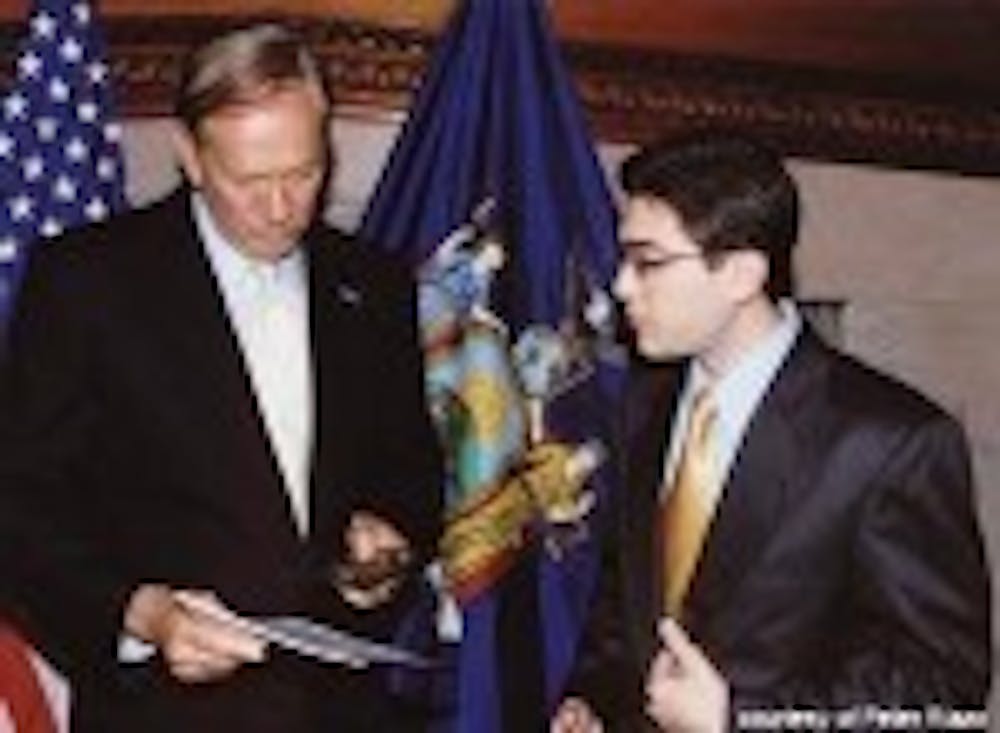
Rizzo said he has, however, been impressed with Gov. George Pataki, who met with Rizzo briefly during the summer after Rizzo sent him a letter explaining his position and his goals in SUNY SA.
Rizzo said he got no such niceties from UB President John Simpson when he requested a meeting as a member of the UB Student Association Assembly.
In the meantime, Rizzo said he and fellow UB delegates - Laura London, Mercedes Tavarez and Brittany Shapiro - are trying to find a balance between SUNY SA and UB. Tavarez, he said, is working on a project involving tuition assistance at UB, and with each delegate working a different issue, all of them are trying to bring the SUNY SA conference to UB in the spring.
Having the conference at a campus would get SUNY SA out of isolated hotels and looking at actual other student governments, Rizzo said. And it might even get UB students looking at SUNY SA.
"The students here don't realize it," he said. "We've got something here that's 100 times better than anywhere else.



