
With Hurricane Katrina's catastrophe dominating the news, and the inevitable effects of time on memory, it seems 9/11 memorials have thinned out in the four years since the attacks that killed thousands.
This year marks the first time since 9/11 that UB itself did not host some sort of vigil or service for the community in memory of the attacks. Memorial services were still held throughout the Buffalo area, though many of them were sparsely attended.
Since 2001, students on campus have attended tributes such as candlelight vigils and seen big names like Lee Ann Womack at athletic games. This year, the only event formally planned to honor 9/11 was the Organization of Arab Students' Unity Picnic.
"I think after last year, it was decided not to do annual programs as had been done in the past. Plans now call for anniversary programs," explained Dennis Black, vice-president for Student Affairs.
He went on to explain that future programs would occur on every fifth year, or later every tenth.
"The 'Unity' program will be holding a barbeque on Sunday in remembrance of 9/11," Black said regarding this year's memorial.
The Organization of Arab Students, led by president Yousif Hassan, held the Unity Picnic Sunday outside of the Student Union.
"After 9/11, people blamed Arabs and made generalizations. We're here to show that we're not like the bad image people have of Arabs." said Hassan, a senior chemical engineering major.
Mazin Kased, Student Association treasurer, was president of OAS and ran the event last year. He appeared this year to help with the tribute.
"It sucks that UB isn't holding a memorial," Kased said. "I'm from NYC, so I can't forget what happened. It was a wake-up call for the country."
Other students, both present at the picnic event and not, held similar sentiments.
"I think it's important for students to have a memorial on campus, because not everyone has transportation to the services in the community," said Rebecca Traub, an art history major in the graduate program. "Maybe the campus should provide busing down there if they're not going to hold a service."
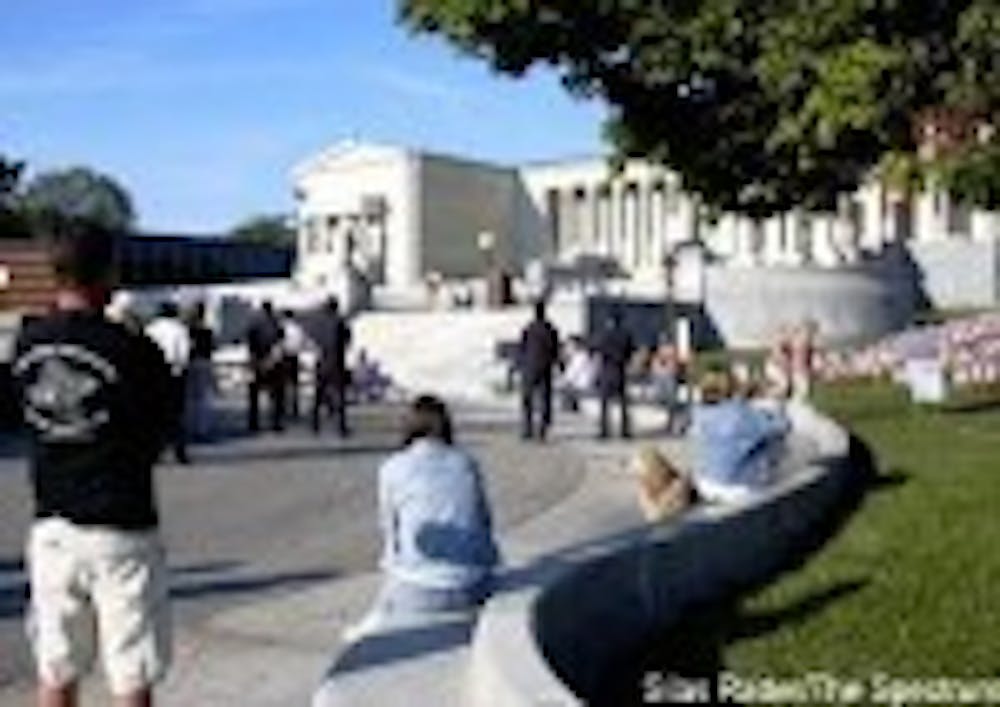
Services like the ones Traub mentioned are still found in the City of Buffalo. Yesterday morning, starting at 8:30 a.m., the Albright Knox hosted a name-reading tribute to remember the victims of 9/11.
Friends and family of the victims took turns reading an alphabetical list of the 2,996 names on the steps of the museum.
At about three seconds per name, with frequent interruptions for moments of remembrance such as "Ave Maria" and respectful silence, the ceremony took several hours. Members of the Buffalo police and fire departments were present to pay their respects as well.
"I think it's a beautiful dedication and a nice tribute for all the people that died," said Dawn Kent, a Buffalo police officer.
The mood was somber, but hardly mournful. Even bearers of the green ribbon given to family and friends of the victims (some pinned over a picture) could be seen smiling occasionally.
Some members of the crowd, however, didn't find much to smile about.
"I'm not happy that the NFL is playing a game today. Football is America's game, now, but couldn't they play last week? Everyone in Buffalo is excited about football," said Tom, 41, a former carpenter for the World Trade Center.
Students on campus had mixed feelings about the attention being paid to 9/11.
"I don't know if the NFL playing has anything to do with it. It shouldn't be that upsetting, really," said Krista Macy, a junior exercise science major.
The administration's decision to hold the memorials with less frequency seems to reflect the mixed feelings of its students. Some, like Traub, support yearly memorials at the very least while others, like Rocco Paone, have less interest in the events.
"My own general reaction is to do my own thing, but if other people want to do that then it's none of my business," said Paone, a senior psychology major.
The next time a formal memorial will be held by UB is next year, according to Black. After that, students won't see one until 2011. Despite the absence of memorial events, many students seem to agree that the event itself has lost no significance.
"It was a big event in American history," said Johnathon Savoy, a freshman aerospace engineering major, "and people should not be allowed to forget what happened."



