
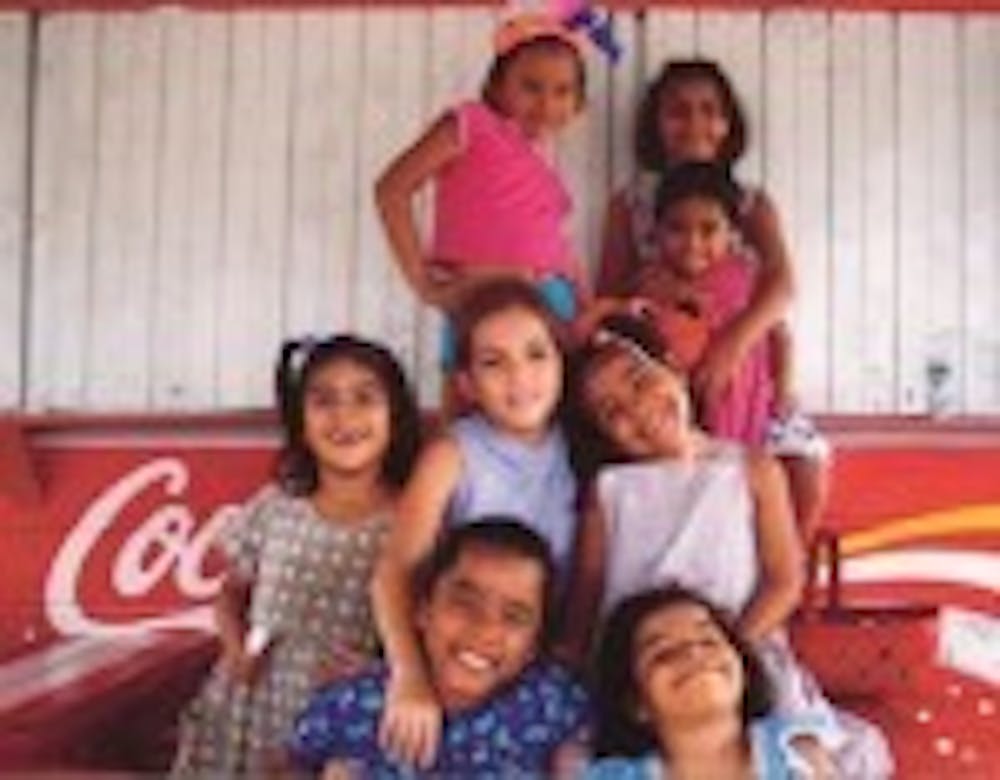
Sharey Edholm and Marley Becker stepped off the bus outside Our Little Roses orphanage home in San Pedro Sula, Honduras. A welcoming sea of little girls, who they had never met, jumped up on them for hugs and kisses, granting them the treatment of long-lost family members.
"It was a truly life-changing experience," said Becker, a program manager at Amherst's People Incorporated, who teaches vocational skills to the mentally disabled. She has visited the home every January for the past three years.
Established by Dr. Diana Frade, Our Little Roses is a home for physically and emotionally abused or orphaned girls in Honduras, aiming to provide them with the tools necessary to rise out of poverty and survive on their own with a supportive environment and an education.
"The goal is to create a middle class in Honduras, and strong women," Edholm said.
Our Little Roses is a non-profit organization driven solely by donations and sponsorships.
It began with 26 girls living in a rented home in 1988 in Honduras. It has since expanded to two large complexes housing over 72 girls, in addition to a bilingual school for the surrounding community's children with approximately 120 students in attendance, and a transitional home for girls continuing their education.
The girls, who range from preschoolers to young adults, cannot be adopted, making Our Little Roses the only female preparatory institution in Honduras.
Honduras is the second poorest country in the Western Hemisphere, with 72 percent of the population living in poverty, 54 percent of which are under the age of 15. There is no public education, and individuals cannot hold a job unless they have completed the sixth grade, resulting in a cycle of poverty that most cannot work their way out of.
"It's poverty like we don't know," said Edholm, a resident of Tonawanda who brings dogs to nursing homes and hospitals as a form of therapy. "Some people are so poor they are forced to give up their children."
As volunteers, Edholm and Becker arrived in January 2005 with suitcases filled with clothing and crafts for the girls. During their visit, Edholm and Becker took the young girls to a nearby swimming pool, Mayan ruins, and hiking through the surrounding mountains. There was also a constant flow of parties and fiestas.
One by one, they came to hear each girl's story.
One girl was brought to Our Little Roses as a bald, malnourished toddler, unable to speak or walk, having spent the first years of her life living in a crate.
Another girl had been given a small amount of change from her mother, and lost it. As punishment, the mother wrapped the girl's legs and set them on fire.
Both girls are now thriving at Our Little Roses.
"They fill you with such love, hope and faith," Becker said. "They just put life back into these girls."
The girls lead a simple, structured existence compared to children living in the United States. Clothes are shared in a community closet. Toys are simple. There are two televisions for them to watch videos on occasion, all of them crowding into a large room. School is in session from February to mid-November.
"They're genuinely happy with having nothing," Edholm said. "It's just so simple to make them happy."
The older girls watch out for the younger girls, acting as sister figures.
Visitors that come on a regular basis brighten up the girls' lives. A lady from New Jersey taught them the art of woodcarving. A hygienist from Massachusetts cleaned their teeth for free.
Edholm sponsors a little girl who was orphaned after the sudden death of her mother. Her date of birth is unknown, though she is estimated to be around seven years old.
"She has no family. Zero. That's why it was important to me to have my family sponsor her so she'll have a family, a big one," Edholm said. She regularly receives and sends mail to the little girl.
Sponsorship is $60 a month, with 100 percent of the money going towards the upbringing of the child. One-time donations are also welcome. For more information visit www.ourlittleroses.org.
Marley Becker splits the cost of sponsorship with a friend.
"$30 is nothing, I'll spend $30 in an hour in a night out," she said.
"One thing about being there is, you never walk alone, there are always two hands in yours," Edholm said, looking through a photo album from her past visit. "Seeing their faces makes me want to go back so bad. I miss them."
Becker said the experience changed her. She is learning Spanish and plans to return with Edholm in January 2006.
"Having the opportunity to spend weeks living with girls that have been abused and abandoned in a third world country changes you as a person," she said. "I look at life in such a different way."



