
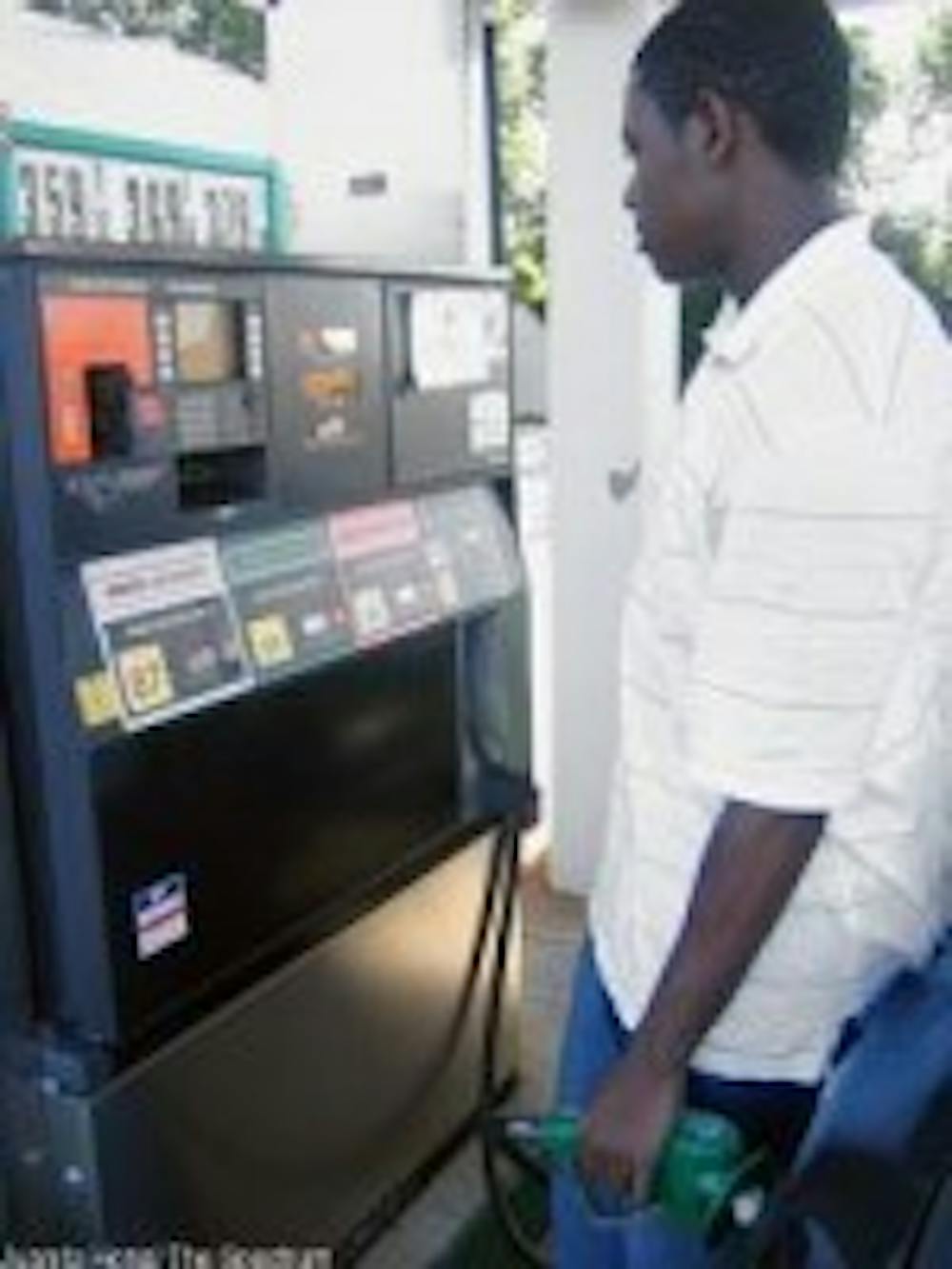
Students commuting from home and between campuses are having no trouble losing weight this semester -- and all of it in their wallets.
With prices nearing $4 at some gas stations this past weekend and just now easing back under $3, many say they've been scrambling for alternatives to ease the financial strain.
"I've been spending $25 on gasoline every five days," said Rob Dettman, a senior management major.
Dettman is one of many students who have been forced to pay extra at the pump to get to school. Every day he commutes from Orchard Park, a 20-minute drive each way.
"If I didn't have a good deal on my utilities, I'd have to move," Dettman said.
But few alternatives are available to students like Dettman who have a limited budget to invest in their transportation.
"I've looked into going with friends to school, even looked at hybrid cars," said Adrianna Huynh, a first-year graduate student who has a 25-minute commute to North Campus.
She also has a job at the Walden Galleria Mall that requires even more travel.
"I used to spend about $25 a week on gas, now I spend $40," Huynh said.
Steve Tricoli, owner of Snyder Automotive Service on Main Street, said he's seen his share of customers upset over the prices at his gas station, but "the summer driving season is part of the problem," and "the current situation is that oil refining has been slowed down by (Hurricane) Katrina."
Rising prices, however, haven't affected his business. People still need to get from place to place and gas consumption has not fallen off.
"We have actually sold more gas this year than last year," said Tricoli, who operates from the corner of Main and Kensington. "The price has not slowed down business at all, at least in terms of pumped gas."
Additionally, gas stations aren't likely to reduce prices - simply because they cannot.
"Our prices are determined by the distributors, so we have limited control," Tricoli said. "Our markup is only pennies per gallon."
Many students said the price hike has caused them to be a little more financially responsible and energy conscious.
"I'm going to cut back on my non-essential driving, and I won't buy stuff I don't need," Dettman said. "I can't just say, 'Oh I'm bored, I'll go to the mall.' "
Huynh said she is in a very similar position.
"I used to go everywhere, but now I just stay home," she said.
While many officials, from UB and national, have recommended that people form carpools or make use of public transportation, many students say those options are only attractive in theory, not in practicality.
"It's too much of an inconvenience to make the bus schedule work." Dettman said. "I'd probably have to drive somewhere for that anyway."
Even if a person can reach a bus station, a prompt arrival is not a guarantee, Huynh said, and a delayed bus can mean not only a missed class, but also a wasted trip and bus pass.
"Waiting is a big issue," she said.
If a student must rely on his own transportation, though, there are a few tricks that can stretch out their dollars. According to Tricoli, frequent maintenance is key to maximizing gas mileage.
"Keep the tires inflated, keep the air filter clean, and keep the car as tuned up as possible," Tricoli said. "Other than that, there's not a whole lot you can do."



