
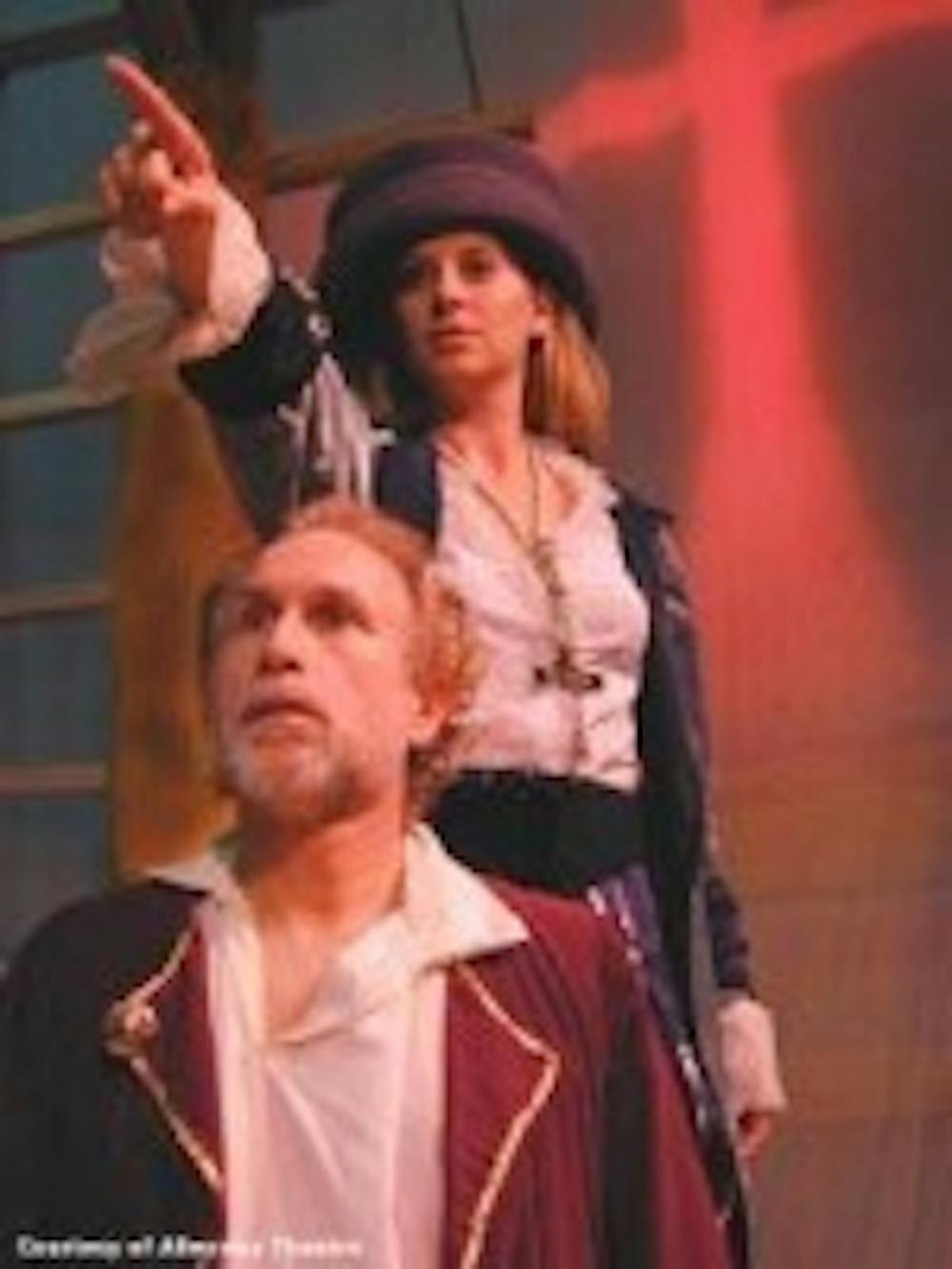
"I probably don't belong in a costume. I should be covered in white wash."
These are the cynical words that the character Historia abruptly declares to the audience in The Alleyway Theatre production, "Columbus." Historia, played by Kim Piazza, tries to scare the truth out of, or into, Christopher Columbus as she haunts him with her angelic voice.
Bobbing and weaving between the audience and actors, she aggressively attempts to intertwine the past and the present. It is not long before the audience realizes that "Christopher Columbus" has intervened upon them.
The play is designed to expose the less honorable side of Columbus' life. Director Neal Radice states that it is meant to be an interactive work.
"I know audiences go to the theatre wanting to know the plot, but truthfully, audiences should go to find out more about themselves. It should force them to reckon with what they accept as truth," Radice said.
Beginning in the second act, the audience is beckoned to come forth and touch the dead Esperanza, a murdered Native American girl played by Gina Serra. While audience members hesitantly come forward, Historia demandingly belts out lyrics.
"TOUCH HER! SHE WAS REAL! TOUCH HER! SHE WAS REAL!" echoed her words through the theatre.
Through this scene, Radice stressed that discerning between what is real and what is false is and always has been a necessary skill, and always will be.
"Theatre is the perfect tool for exploring with the audience, and our ability to discern what is and isn't true," he said.
The play was adapted from its original version by Robert Kornhiser. Radice became interested in reformatting the play.
"I did so because I'm old and I have too much time on my hands," Radice said, jokingly. "The lyrical quality inspired me to turn it into a musical. We found ourselves injecting music into the show and we thought it lent itself to music very well."
Although melodic, the play readily overlooks aesthetics in order to achieve reality. Radice encourages the audience to apply "Columbus" to our current political situation.
"This play is about hubris," Radice said. "If you get all the way through this play and think that I haven't been mentioning Iraq, then we have failed in some way."
The connection Radice attempts to make between ancient history and 21st century politics is almost too ambitious. Yet, he manages to conduct a graceful play by infusing a sense of humor, something any viewer can appreciate despite their interest in current or historic events.
John Study, who plays Columbus, acts with the lunacy of Shakespeare's King Lear (or maybe some other widely distrusted figurehead). Historia sneers while Columbus fumbles his good intentions and clumsily destroys those around him.
Even his closest cohorts, like Lear's daughters, conspire against him in spite of his foppery. For moments, the audience is suspended in disbelief. How can our historical foundation have been so carelessly laid?
The voyage is described as a "futile expedition of the ultimate price," by one of the crewmembers. Historia refers to the sea on which Columbus set sail as being "green" while the old memory device clearly states that Columbus sailed an ocean "blue."
Green spotlights relentlessly bathe each scene in a festering pool of greed. The characters and their clarity of consciousness begin to waver and eventually capsize. Laissez-faire, no longer as innocent as it had appeared in textbooks, begins to resemble piracy.
The backdrop of music is sapless in comparison to the lush vocals. The play lacks organic instrumentals because much of the music has been pre-recorded and punched through a keyboard. Yet the players do an incredible job of compensating, rousing the good old-fashioned theme of man versus machine.
"Look folks," Radice said, "if the history lessons you were taught in school were so far from the truth, why should you still be trusting? The question is, 'Are you a good skeptic?'"
Roldan, played by Tom Owen, accepts the lawless and barbaric circumstances and wistfully admits to having discarded his consciousness.
"A heartless arm is best," he says.
Death, greed, slavery, recklessness, gluttony, pride, murder, vanity, rape, disease, betrayal and ultimately hubris contribute to the debasement of this preemptive voyage. Despite the weighty subject matter, it is recommended that the audience laugh at its ugly truths, or at least our ugly truths.
"Columbus" opens Sept. 15 at The Alleyway Theatre.



