
While the Albright Knox Art Gallery has always been at the forefront when it comes to displaying and discovering abstract art, they've set a new precedent this summer.
"Extreme Abstraction," the Gallery's latest exhibition, premiered on July 15 and runs through Oct. 2. Normally, special shows at the Gallery are tucked away in smaller rooms, but this particular selection has pushed familiar pieces out of the spotlight.
Many of the pieces are what viewers might think of as typical abstract art that include large works of bright colors and vivid patterns. Ingrid Calame's "Secular Response" fits the stereotype, with large avocado green and white splat patterns across one of the Gallery's larger walls.
Or take Angela Leach's "AR-Wave #8," in which psychedelic waves outline mountains and valleys using only simple parallel lines and sudden breaks in color to illustrate a rippling terrain.
Pae White breaks up the ironic monotony of all the bright colors with "Au lover," a large woven cotton-and-thread piece depicting a sewn, crumpled-metal landscape on a large piece of fabric complete with dull and tarnished hues. Surprisingly, the lack of color attracts attention because of its placement next to other flamboyant works.
With an exhibition of abstract nature on such a large scale, all the optical illusions and ambiguous meanings can become tiresome after the fourth or fifth room. A viewer can only see so many pseudo-futuristic vertical stripe pieces before they crave an encrypted significance to contemplate and interpret.
The Gallery has placed several site-specific installations throughout the exhibit, in order to combat this craving. These are pieces unique to the Gallery, painted onto its walls and floors, making the space that the piece occupies a part of the work.
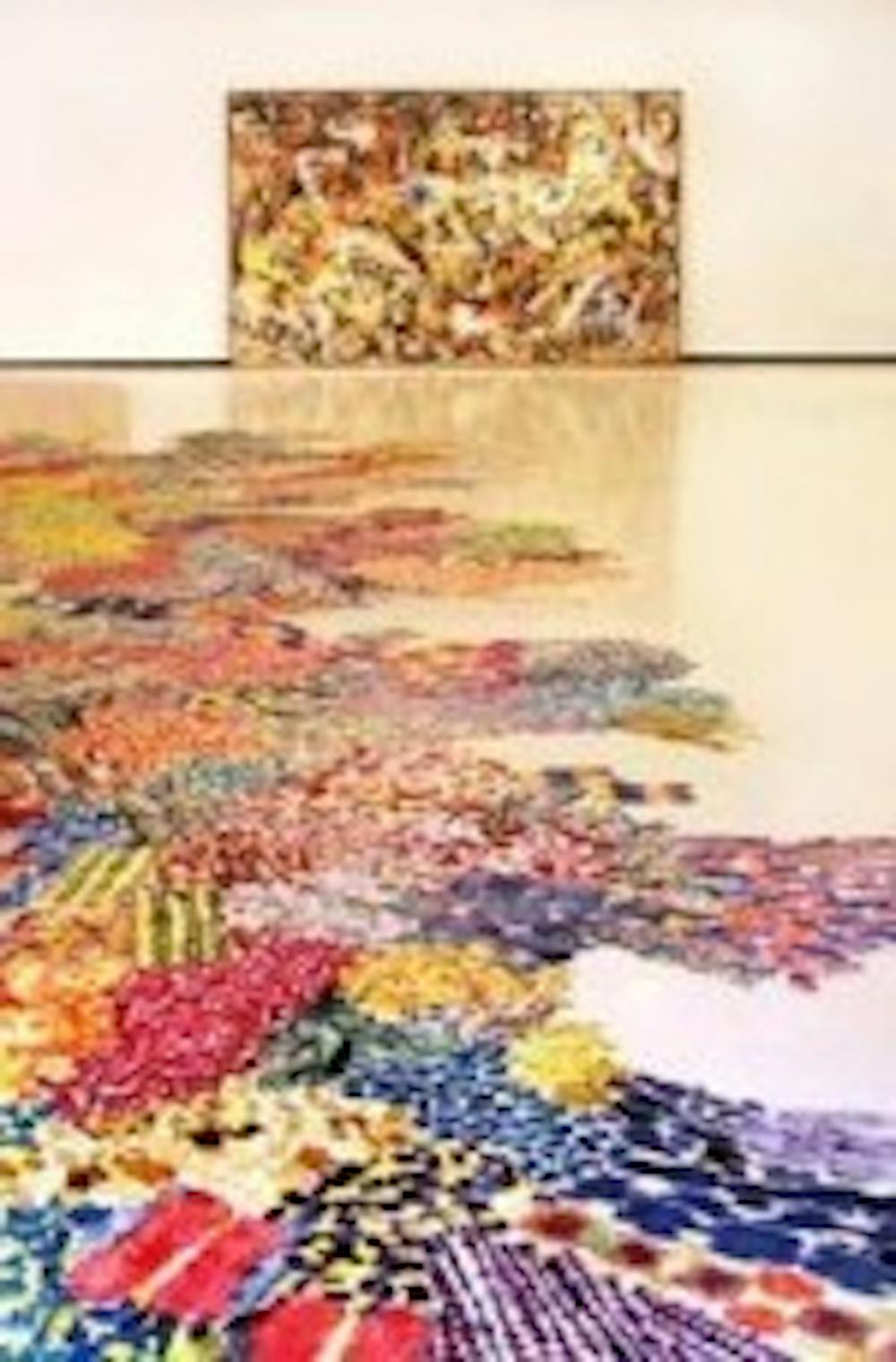
Interior designers might find inspiration in Polly Apfelbaum's "Reckless," a synthetic velvet installation laid down upon the Gallery's simple, white, tile floor. The segmented, multicolored paint patterns sprawl out to form a liquid patchwork across nearly an entire room with edges like spilt milk, mocking any kind of beginning or end to the piece.
Morris Louis's "Alpha" is particularly enthralling, consisting of an enclosed room with viewing windows packed to the edge with tiny ceramic cups, each containing a different dye of paint. The most fascinating aspect about this piece is envisioning the installation process that Louis went through, lining each petite cup beside the next and deciding which shades looked just right, until the entire surface of the vast floor was covered.
Imagining an artist fashioning part of their work while actually inside of a gallery helps bring the art to an accessible and identifiable level of comprehension.
There are 18 site-specific installations in all, each adorning the familiar spaces of the Gallery in unique ways that force the viewer to become more interactive with the environment.
"Plaza," by Jim Lambie, is an installation that features several colored plastic bags hung haphazardly from the stark white wall. Each bag has a contrasting colored paint dripping from the bottom of it, and these liquids have been allowed to drip down Gallery's wall and form pools on the floor.
Contemporary abstract art made up the bulk of the displayed art, but several reminders of how the Gallery began its journey still remain, like Jackson Pollock's masterwork, "Convergence."
"Stacked Revision Structure," a large multicolored block by Liam Gillick, awaits patrons outside of the Gallery's back steps to contrast with the rolling hills.
Like Gillick's piece, "Extreme Abstraction" with its strange arrangements and exceptional art, is a refreshing spark of vitality for the Albright Knox Art Gallery.



