
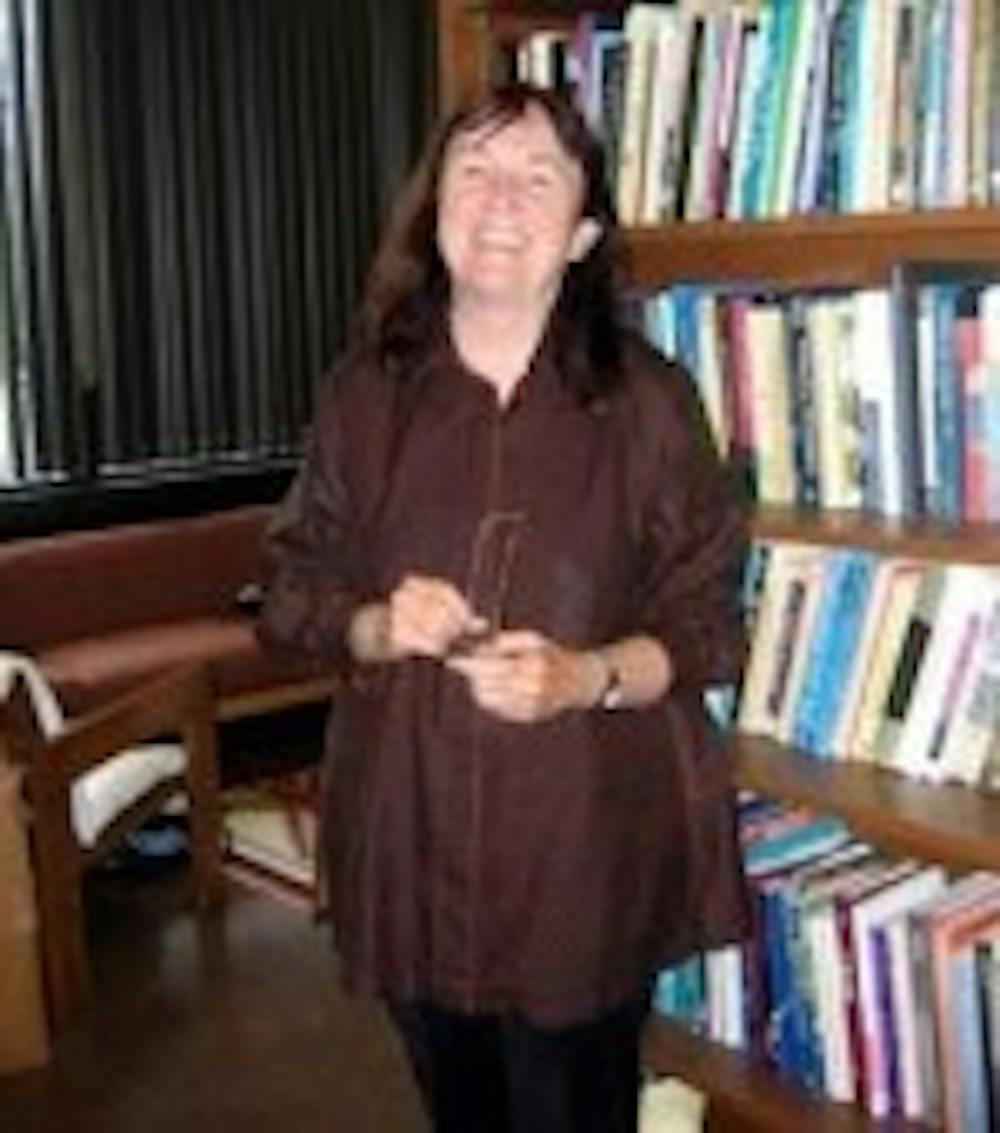
Since the publication of her book, "The Woman in the Shaman's Body: Reclaiming the Feminine in Religion and Medicine," life for Barbara Tedlock, a distinguished teaching professor at UB, has been one wild ride.
Her book, which is in the process of being translated into Danish, German, French, Spanish and Turkish, has garnered worldwide attention as a text on the practice of Shamanism, the world's oldest form of religion and medicine that is still widely used today.
Tedlock spent part of the summer months traveling back to Guatemala, where she filmed additional footage for a six-hour documentary titled "Breaking the Maya Code," that will air on PBS in November.
Night Fire Film, a small production company based in LA, approached Tedlock seven years ago at the inception of the project. She aided the owners of the company from across the country as they checked facts and began to conceptualize the theme of the film.
"They wanted to make a film different from all other Mayan films," Tedlock said.
Funding for the company was unavailable at the time, and Tedlock did not hear back from them until a year ago. David Lebrun, director of Night Fire Film had received backing from both the National Science Foundation and the National Endowment for the Humanities.
In January and February of 2005, Tedlock, along with her husband, Professor Dennis Tedlock and academic Michael Coe, spent six weeks serving as the documentary's anchors, utilizing their respective areas of expertise. They led the crew through ancient sites in Guatemala that had never been filmed in traditional documentaries, and that are, for the most part, still used today.
The documentary aimed to provide an accurate depiction of living Maya and their connection with Shamanism and the modern world, opposing documentaries that depict a dead culture.
They lead the crew to Utatlan, where there are four connected, manmade tunnels built underneath volcanic tuft, which lead to a living shrine. They also traveled to the town of Rabinal, where they recorded the performance of traditional costume dance dramas.
Also featured in the documentaries is the town of Momostenango, where new Shamans are trained and then initiated with approximately 20,000 people in attendance, another facet of Maya life never before recorded.
"It's one of those things American culture has never seen before, and that the Maya culture is thrilled to share," Tedlock said.
Tedlock said the crew was surprised at the enormity of the event.
"I don't think that's what they expected, it to be such a big deal," she said.
During filming, the crew stayed at a variety of accommodations. Sometimes it was a fancy hotel complete with a three-course meal, and others it was a crude straw mattress on the floor with black beans for dinner.
When they got wind of "Breaking the Maya Code," the History Channel approached Tedlock and her husband for another television opportunity. During the second week of her stay in Guatemala in August, they filmed two segments of a film recording traditional Maya sites. At the end of September they will fly to Burbank, CA to finish recording, and the piece will air in January.
Tedlock will not be slowing down anytime soon.
In March 2006, she will be leading a nine-day tour through Guatemala, consisting of 20 to 30 people along with her husband, through an experienced tour group.
It will be a new experience for the couple, whose touring guide experience consists of lecturing on cruises.
After traveling to Mongolia this summer for research purposes, she met Mongolians interested in traveling to Buffalo to meet Native Americans.
"They believe that they're connected," Tedlock said.
She hopes to plan a trip for them in January and February, when the climate in Buffalo is similar to that in Mongolia.
"You would think we would be the most hated nations, but there are some countries that are very positive towards the US, Mongolia being one of them," she said.
According to Tedlock, Shamanism may be an ancient tradition, but 27 medical schools and hospitals in the United States are teaching alternative healing practices, including Stanford. It is called integrative medicine and is being used in such lofty fields as cancer treatment.
In between juggling the semester's class schedule, Tedlock will continue appearing on radio programs across the country, as well as lectures and book signings.
This past summer she appeared on Danish public radio stations in Copenhagen, and she will appear on the television program "Shaman's Den," Sept. 5, 8 and 10 on Berkeley Public Television, Channel 28.
Additional information can be accessed at
In the meantime, Tedlock is enjoying the worldwide interest in her novel.
"This is like a dream come true," she said.



