
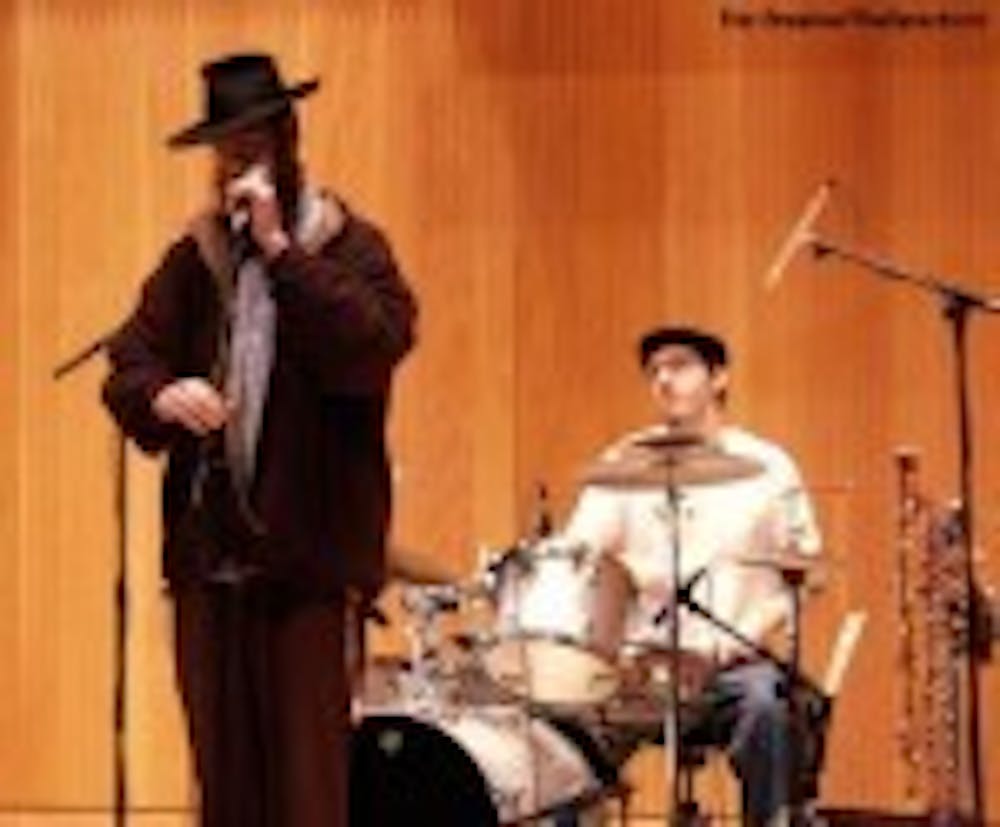
Slee Hall hosted an artist who could be the strangest and most amazing thing to happen to Judaism and reggae, well, ever. A unique Orthodox Jew by the name of Matisyahu uses reggae music as a platform to expose his feelings on the rich heritage of Judaism.
He proved he is not to be underestimated, giving a performance capable of converting the most skeptical listener.
His birth name is Matthew Miller, although he performs under the sobriquet Matisyahu, a rough Hebrew translation of his name. He converted to Hasidism, an Orthodox form of Judaism, during his college years. That doesn't stop him from using some unorthodox means to get his positive message across.
Don't be fooled. Matisyahu is not a novelty act. It is clear from his enticing performance that he is a man who has studied the nuances of reggae. His ethereal voice is chill inducing.
He sings about a myriad of Jewish subject matter, from Bible stories to mediations on living a Jewish lifestyle.
People of many different backgrounds gathered for Matisyahu's performance. His outlook was refreshing and not too preachy, and his reggae sound was as authentic to Marley and Peter Tosh as you'll get outside of Jamaica.
In "Chop 'Em Down," he sings about the Jewish diaspora from Egypt, professing "Rip through Egypt, rip through it/ get into it, 600,000 witnessed it/ no, you didn't forget." His ability to integrate Biblical stories and work them seamlessly into the constructs of reggae music shows some of the insight he had in choosing reggae as the vehicle to carry his message.
In "Got No Water," he uses the metaphor of a thirst to express God's ability to spiritually quench the thirst of those who seek knowledge. "I give myself to you because you treat me right/ put my trust in the world and the world gets tight/ shift my trust to you it's like a crystal clear night."
By far, the highlight was the song "King Without A Crown" - a rapid-fire set of lyrics to a bouncy guitar line that was pure reggae bliss. It allowed Matisyahu to show off his abilities to their fullest extent. "If you're trying to stay high then you're bound to stay low/ you want God but you can't deflate your ego."
He pontificates on integrity, and modesty before God. His rhymes are so enchanting, you can often get lost in the play of words and the way they melt together in each verse.
After a period of chanting in Hebrew, he offered something akin to a live remix, by beatboxing the chants, breaking them up into danceable beats, and briefly giving the audience his rendition of the robot.
Matisyahu's relaxed attitude and stage presence gave extra force to his lyrics. He sat with poise, perched atop the speakers, letting his fellow band members, the riff-heavy guitarist Aaron Dugan, frenzied drummer Jonah David, and bassist Josh Werner bust out grooves that would be right at home in Kingston, Jamaica. Their unpretentious setup proved effective in creating a sonic landscape that helped Matisyahu's songs come to life.
Matisyahu's music represents a dichotomy. It sounds fresh enough to appeal to many students in the audience in tandem with rabbis. His positive Jewish message appealed to religious sensibilities.
The seemingly disparate worlds of reggae culture and Hasidism are bridged, and a parallel yearning becomes clear. The yearning of the spirit is not specific to one culture or religion, it is a universal element, and through the erudite voice of Matisyahu, it's not to be missed.



