
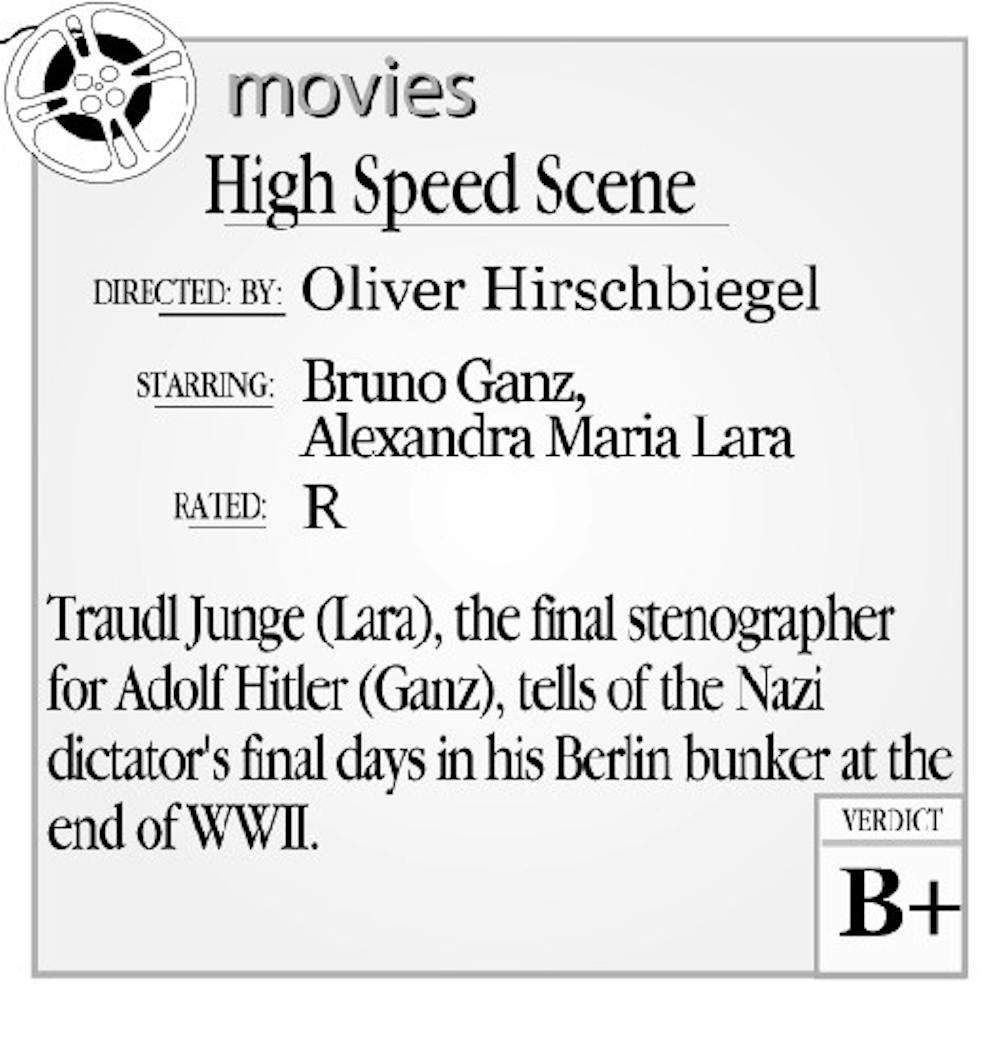
In 1942, Traudl Junge, a 22-year-old secretary, is introduced to her new employer at a military headquarters in East Prussia. On her first day she's nervous. She can't type his oratory quick enough and she worries that she'll be replaced. But her soft-spoken boss makes her feel at ease.
"Let's try that again," he says.
He's compassionate and cordial; he's fair and forgiving.
He's also addressed as "My Fuhrer."
The German-made movie "Downfall" accounts the final days of World War II inside Hitler's Berlin bunker just before Germany surrendered in 1945. It's adapted from Joachim Fest's book "Inside Hitler's Bunker," and Traudl Junge's "Until the Final Hour."
At the center of the concrete crypt is Adolf Hitler, played by Bruno Ganz. He's the Hitler everyone remembers from history class. He's brutal. He's insane. He's Satan with a tiny mustache.
He rants in maniacal monologues condemning the Jews and the German people for the lost war. He orders that Berlin be destroyed and its inhabitants die traitors' deaths.
"Compassion is a primal sin. Compassion is for the weak," Hitler says to his mistress Eva Braun (Juliane Kohler).
However, Director Oliver Hirschbiegel traverses uncharted cinematic territory with his characterization of Hitler.
He shows the human side.
Such a characterization is atypical for portrayals of the nazi dictator. Past films like "The Bunker" (1981) starring Anthony Hopkins and "Hitler: The Last Ten Days" (1973) with Alec Guinness showed only the dictator's demonic side.
Swiss-born Ganz conveys the man and the monster with uncanny conviction. His portrayal of Hitler's two-facedness will go down in history as one of the greatest and most compelling embodiments of a historical figure.
When Hitler is with Eva or Traudl (Alexandra Maria Lara) he's not the Fuhrer, but a regular guy. He pets his dog Blondi, enjoys meals with his secretaries, and listens to the Goebbels children sing patriotic German songs.
"We want to see Uncle Hitler," say the children of Josef Goebbels, Hitler's Minister of Propaganda.
The controversy that surrounds "Downfall" is immense, but that's only because the portrayal is fair. It's easy to give the most hated man in history a one-sided portrayal, but Hirschbiegel aims for complete historical accuracy in depicting Hitler's last days. If that meant humanizing him, then so be it.
Hirschbiegel occasionally leaves the confines of the claustrophobic bunker, surveying the outskirts of the war-ravaged Berlin. For a movie primarily focused on dialogue, the action is surprisingly impressive. Huge explosions from Soviet shells and an impeccable scenic representation of the devastated capital city add a visual element to the movie.
Inside the bunker, Hitler interacts with his group of military minions including Goebbels (Ulrich Matthes), Albert Speer (Heino Ferch), Heinrich Himmler (Ulrich Noethen), and Wilhelm Mohnke (Andre Hennicke) among others.
The many names and faces will be hard to follow for anyone that isn't a history major or a World War II buff. Hirschbiegel's dedication to historical accuracy detracts from what could have been a meaningful dramatic interpretation.
If Shakespeare were to put this history onto stage he would have probed into the meaning of life and death by dramatizing its characters and exaggerating the events that occurred in the bunker. Hitler's suicide would have been a grand culmination with one final theatrical speech before putting the gun to his head and ending his tragic existence.
Hirschbiegel includes no dramatic speeches. Nor does he insert any philosophical rhetoric about the meaning of life and death.
The World War II setting has allowed films like "The Thin Red Line" and "Saving Private Ryan" to implement meaningful themes and theoretical subject matter. "Downfall" was so tightly bound with its goal of historical accuracy it almost resembles a docudrama. The film is unable to artistically expand from the confines of historical fact.
Shakespeare's plays are able to stand the test of time because he transformed history into drama. "Downfall" does not attempt to do so, and relies wholly on history for plot. However, Hirschbiegel must be commended for not trying to dramatize a story into something that it was not. No one needs another "Pearl Harbor."
The movie is the first of its kind with relation to Hitler because it's honest, true and has a performance that will be remembered, even if the film is not.



