
Jimmy Heath knew he needed help.
A photojournalist from Over-the-Rhine, a neighborhood in Cincinnati, Ohio, Heath found himself homeless. He came to Over-the-Rhine as a homeless person in 1995, addicted to drugs and alcohol.
Then he discovered the Drop Inn Center, a place for rehabilitation.
After completing his recovery, he found new inspiration for his work and his life. Jimmy used his camera as a tool to capture life in the inner-city neighborhood that once offered its curbs as a bed.
He has assembled a group of these photographs in his installment at the College Street Gallery, "Broken City."
"I'm very lucky," he said as we stood in front of pictures he shot of his hometown at the gallery, located at 244 Allen St. in Buffalo. "I'm very fortunate that I'm even here to do this. When I went to recovery, they saved my life."
Heath says he was always artistic. Whether drawing or painting, he loved the expression that he found in art.
Around his early twenties, Heath stumbled upon photography. He was getting bored with drawing and painting and didn't consider himself especially talented.
However, when he picked up a camera he found his true talent. He was able to capture things in an essence he never knew he could.
Heath now teaches a photography class at a community college in his hometown. Anyone within 15 miles may enroll for his class.
When asked if he was doing this to try to keep kids off the street, he said with a half-hearted smile and a sigh, "I wish, I guess ... I hope so."
"It's not about me trying to rescue them but them rescuing themselves," Heath said.
With such an inspiring story behind the man with the lens, it's tempting to take a look at his photographs and try to assume his outlook.
The pictures he had taken of his home in Over-the-Rhine hung in a room no bigger than 15 by 8 feet. They covered all three sides of the white walls suspended in a straight line. Some were bursting with color and others were as grey as the feeling you got from looking at them.
How sad it was to look upon a place that looked like a Third World country and realize there are Americans who live like this.
One continues through the exhibit, looking at the faces of children with no homes.
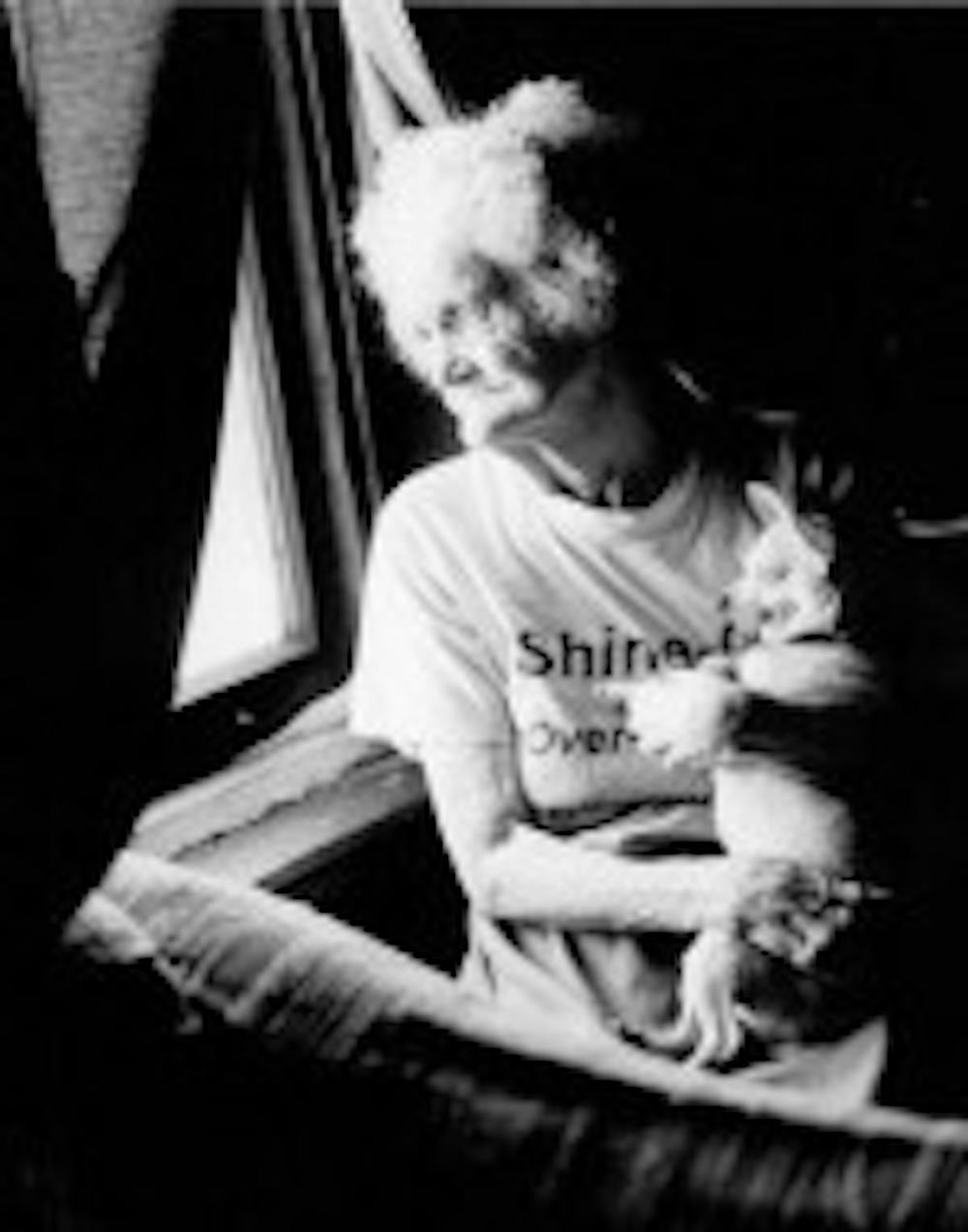
A picture titled "Helen Edwards and Her Dog Wiggles" is emotionally powerful. The picture captures the subject in her apartment, holding her dog, lit by only the sunlight.
This black and white photograph depicted a life of poverty, not just the act of being without a home. Her spirit seemed to have left her long ago and there was an absence of hope and faith in those sad, sorrowful eyes. She was weathered with grief, though this picture should have captured her on one of the happiest days of her life: her 80th birthday.
Several of the photographs are touching in a way that made it hard to look the subjects in the eye. What was wonderful about this exhibition was Heath's ability to break up the sorrow with the beauty he found in Over-the-Rhine.
A few wall spaces below the shot of Helen were photos of an event called The Secret Garden. Here, radiant sunflowers hang from the wall amidst the grey, bringing the gallery to life. Coupled with the sunflowers hangs a picture of children swimming in a pool. A very simple picture, but bright in contrast.
Jimmy Heath's story is an inspiration, and "Broken City" will serve as a reminder to many people of their good fortune.
Those interested are encouraged to visit Heath's site, www.jimmyheath.org.



