
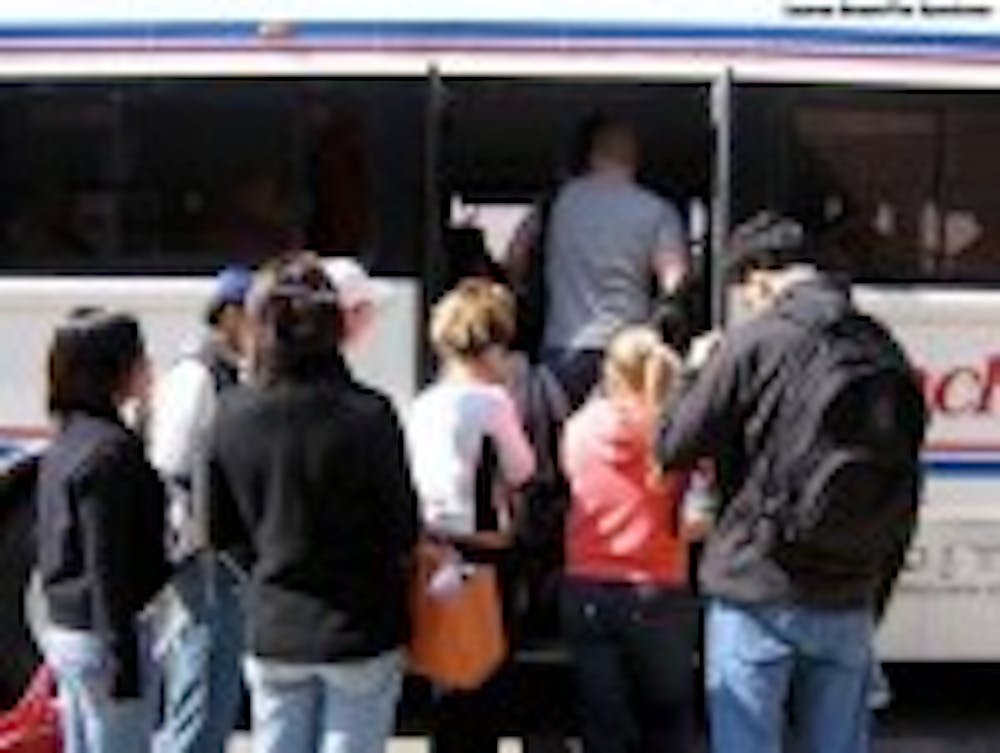
It's 4:25 p.m. at Lee Loop on North Campus. A bus should be here to take students home to South Campus, but it's not.
Five minutes later, another bus is scheduled to depart for South, but it too fails to arrive. The crowd around the bus stop swells to nearly 40.
By 4:37 p.m. there should have been two more buses. A minibus arrives and the crowd bottlenecks to pack onto the small shuttle, which leaves most of the commuters behind. Leila Sermek, a graduate student, throws her hands in the air and resigns herself to waiting for the next bus.
"This is awful," she said. "People are paying a lot of money for transportation."
More and more, as UB nears the end of its 25 years with Coach USA busing, students and other regular commuters are throwing up their hands in frustration. Many complain about wait times, and some say there aren't enough buses. Some don't know who to blame, while others say it's the drivers.
In the eyes of Parking and Transportation officials, every complaint from their riders is serious, but not all of the problems are as bad as they seem.
"Given the number of people we transport, the number of complaints is minimal," said Maria Wallace, interim director of Parking and Transportation.
Wallace said many of the problems with UB transportation are perceived, but some of them are real and have tangible impacts, which is what concerns her the most.
And now, officials say help is on the way: UB has signed a new bus contact with Cognisa, a company that boasts 99 percent accuracy at Texas State University.
Whether that means 99 percent is in UB's future too, however, remains to be seen.
Challenges loom
On any given weekday, about 18,000 people use the UB buses. Five buses run between Ellicott and Lee Loop at peak hours, and 14 run between campuses. Especially for the buses between North and South, drivers often face problems beyond their control, according to Chris Austin, adjudication and transportation coordinator.
The weather, traffic on Millersport Highway and construction lead to many of the time problems, he said.
"Buses can easily begin to bunch when that traffic begins, and there are clearly not alternatives to that route," Austin said.
Cognisa, which signed a five-year, $11 million deal with UB, has already faced problems like these at Texas State University, where company spokesperson Sara Pilling said they are 99 percent accurate.
But that percentage, according to Texas State officials, does not apply as much to the routes off campus. Texas State does not have an inter-campus route, and off-campus buses to nearby Austin, Tex., face similar time problems to UB's.
"We've got some challenges in terms of the city of San Marcos. We have traffic delays that are many times out of our control," said John Root, director of auxiliary services at Texas State. "Other than those things, I would say the 99 percent is accurate."
Root said a major benefit of Cognisa is the on-site manager they provide, adding the relationship with the company has been an overall very positive experience.
Wallace, the interim director of transportation at UB, also touted Cognisa's people skills. The on-campus manger, she said, will go a long way towards making improvements, especially in communication between UB and the local Cognisa hub.
"Obviously we can't control Millersport (Highway), but we can build into our current schedule and route a gauge for those things," she said.
"From my standpoint I'd prefer not to have any of these types of issues," Wallace added. "And clearly I don't want any students, let alone one student, missing a bus and perhaps missing a class or lecture."
Spectrum investigation
Sermek, who lives in University Heights and studies environmental engineering, said the inconsistent bus services often wastes time in her daily schedule. As a teaching assistant, she said she is often late to class in the morning because of the buses and has called Parking and Transportation to complain.
According to UB officials, Sermek isn't the only student they've heard from, and they know there's a general problem.
"There are peak periods when services is efficient, and there have certainly been times where we would have liked the service to be more efficient," Austin said.
Austin said the transportation department keeps daily tabs on the buses between campuses and between Ellicott and the academic spine. Current statistics show UB buses are running at 73 to 75 percent on-time accuracy, he said.
Despite the records the department keeps, an informal investigation by The Spectrum in February showed that consistency and bus availability, rather than simple timeliness, might be at the heart of the problem.
Few of the South Campus buses during select weekday shifts, which included both peak and non-peak hours, met the exact schedule minutes, but many were within two or three minutes, which Austin said is the leeway the department gives drivers.
None of the hour-long shifts, however, saw the scheduled number of buses arrive or depart. Some were close: for one shift between 2 p.m. and 3 p.m., there were 13 out of 15. But in other shifts, only around half arrived. One shift from 3 p.m. to 4 p.m. saw only six out of 15. Another had seven out of 15.
South Campus buses also have problems with bunching: a bus won't come for 20 minutes and then three will arrive at once. With 14 buses running between campuses, three buses arriving at once might not seem like a problem, but it can happen as many as eight times in an hour. Plus, all the students get on one bus, leaving the other two to sit.
The route between Ellicott and Lee Loop is far more efficient, but still inconsistent. Some hours are perfect with the schedule: 20 buses, one bus every three minutes, zero minutes without at least one bus at the stop. Another day in the same peak time had 15 buses, and only 30 percent of the time had buses arriving when others departed, leaving nearly 20 minutes when the bus stop was empty.
At 5 p.m., the Ellicott route is incorporated into the inter-campus route for the evening schedule, which makes for a further lack of buses. Plus, at night, students better be at the stop at the right time: many buses stay at the stop for less than a minute.
'Eyes and ears'
Some frequent riders of the buses said they believe part of the blame might lie with the drivers. According to Austin, driver shifts range from five to 10 hours, and "it's difficult to plan certain human-related breaks."
Those shifts, along with break polices, are set by the bus company. But even if they weren't, Austin said he doesn't think the main problems are the fault of the drivers, all of whom will have the opportunity to work at UB for Cognisa.
Wallace said the contract with Cognisa was signed because they were the lowest bidder. The contract, she said, was based on the rising cost of diesel fuel, not necessarily timeliness, but there are major improvements UB hopes to make with the new company.
Austin said he urges patience and communication between students and officials.
"The students and ridership, they are, in great part, our eyes and ears of the service," he said.
While many said they think UB could use more buses, Austin said he doesn't think that's the answer because "while it may clear up 30 to 45 students at a stop, the bus is then going into that system" of bunching.
With the Cognisa buses set to debut in May, students continue to vent their frustration.
Christina Matteliano, a sophomore anthropology major, said its "very frustrating" because even if you get to an Ellicott bus early, "the buses get full and you can't get on it, even if you've been waiting for a long time."
Matteliano suggested officials reverse the Ellicott route to make it shorter. Some students, like Shawn Choi, a freshman undecided major, said the Ellicott buses aren't perfect, but he's moving to Ellicott next semester because the commute is so bad.
Sunu Mathew, graduate student in computer science who lives on South Campus, said there needs to be more buses on the weekends.
"It's not too bad though," he said.
Fletcher Chapin, a junior electrical engineering major who lives on South Campus, said he's waited as long as 45 minutes for a bus to come, and then had to wait another 45 minutes when the first one filled up.
"The reason it's inconsistent is that there aren't enough buses," he said. "The guys who drive it, they do the best they can to stick to the schedule, but there's not a lot you can do about it."



