
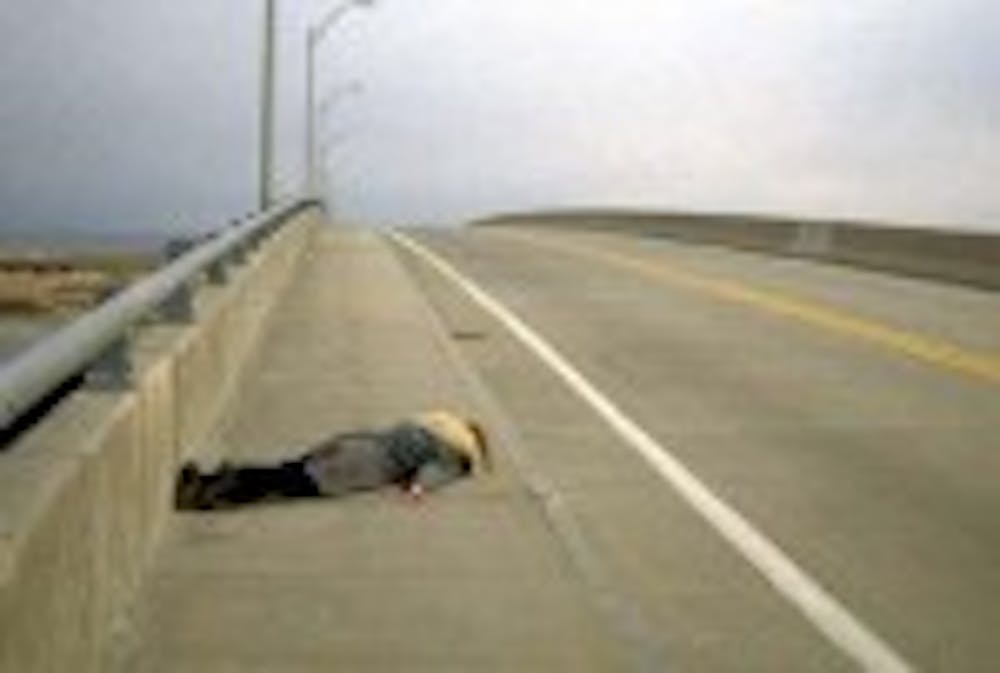
"When we visit a place, we die a little as we leave our stories there," said Janaina Tsch?_pe.
Tsch?_pe's photographic images from the series "100 Little Deaths" are pictures she took of herself laying, as if dead, in different locations. She's an artist with a dual identity drawn from her German and Brazilian heritage.
While her background is mixed, her visual vocabulary presents a type of common dialect, grounded in the search for her relationship to nature. She incorporates elements of her dual heritage, including depictions ranging from German romanticism in "100 Little Deaths" to mythical creatures in the greenery of Brazil in "After the Rain."
"('100 Little Deaths' is) a ritualistic search we all conduct," Tsch?_pe said. "(This search) reflects our loneliness."
Tsch?_pe speaks excitedly and abstractly of her intentions, like many artists trying to describe their work.
"In a person's search for their place in life, they are often found alone. I find this concept to be the romance of solitude," she said.
Her work is a recording of a multitude of locations that she visited with only one partner: her camera. The "deaths" are linked to locations as varied as Germany, Brazil, France, Pittsburgh, Capri, Long Island, and Cambodia. She worked on the project from 1997 to 2002 with the intent of detaching herself from the studio and its sterile white space. She wanted to form a bond with her environment by using only herself and her camera.
Another project featured, "He drowned in her eyes as she called him to follow," is a series she worked on from 1999-2000. In this series, she becomes a mermaid, and using herself and her camera, she places the mermaid in an indoor space. She deconstructs notions of the mermaid as seducer, and explores the function the creature serves.
"Why did man invent this myth?" she asks. The question she poses serves as a type of artist's statement for "He drowned ..." She studies the social ramifications of the myth.
Tsch?_pe views her body in the video as a vehicle to express the conceivably problematic nature of the mermaid, and how the mermaid would function out of water, and in a domestic setting.
"Should they remain in water forever?" she asks. This delightful possibility creates an intimate, confrontational view, which neither objectifies nor eroticizes.
In a 2003 series, "After the Rain," Tsch?_pe showcases Brazil in a series of photographs. Her models are friends, clearly preferring the intimacy of those who are close to her. She constructed inflatable clothes that were filled with water for the models that inhibited movement and captured the unique statuesque moment through photography. She demonstrates the power of her environment in this series. It manifests itself as a living thing.
"The rain is so strong in Brazil, things are changed in a second," she said. The manifestation of nature's dynamic is personified in images of these creatures that, while mythical in origin, are tied to our experiences and our relationship to nature. Her creatures exist in a state of prelapsarian glory, a pure form of nature, and its sometimes elusive mysterious qualities.
Tsch?_pe feels her strongest connection is to Brazil, but she resides in New York City. Her experiences abroad have shaped her aesthetic sensibilities. Through her travels, she has been exposed to different forms of artistic expression.
She has learned that the European view of art, which is narrow in character and scope, limits one to the type of art that they can create. She removes these limitations in her work, and explores creativity which is not bound by geographical borders.



