
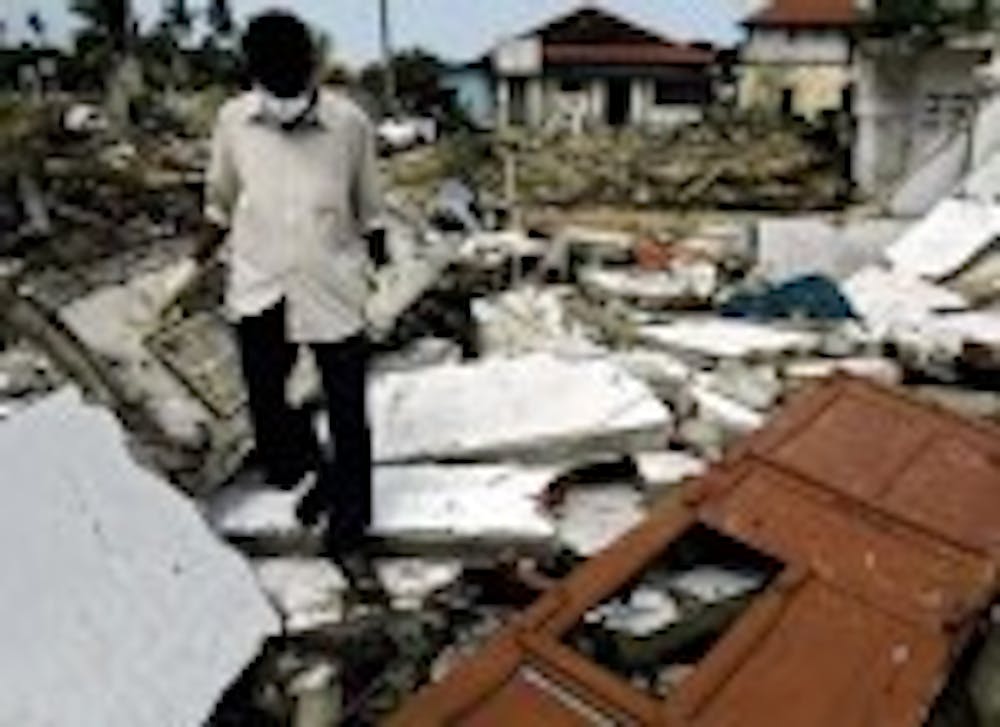
With the catastrophic damage from the tsunami in Southeast Asia still fresh in the public's mind, new measures for minimizing the damage from natural or man-made disasters are being researched at UB.
The research team, which includes faculty and students from UB, the University of Virginia, the University of Arkansas and outside consultants, has been working on the project using information fusion.
Information fusion involves taking a number of pieces of data and combining them into a clear picture of the situation, said Peter Scott, associate professor of computer science and principal investigator. It can also work with artificial intelligence in the military, he added, in addition to being used in the aftermath of a disaster.
"We picked up this challenge because there was a need to know how to structure this information flow to be of maximum use to the decision makers," Scott said.
The program is funded by a $2.5 million grant from the Air Force Office of Scientific Research. Scott said information fusion could have been applied to disasters like the 1994 earthquake in Northridge, Calif. and could also be useful in evaluating other situations of similar magnitude in the event one should arise.
"The point of information fusion is to systematically evaluate and correlate the information in these reports," Scott said.
Scott used an example of a police cruiser that saw an injured civilian in the aftermath of an earthquake and reported the incident, and at the same time, a passer-by saw and reported the same incident, which could potentially cause confusion.
With information fusion, however, Scott said the new process would allow the 911 dispatcher to recognize the two incidents as the same situation, reducing the initial uncertainty.
"Life-and-death decisions are being made, and information fusion will help sort the details," Scott said.
An additional aim of the project is to minimize the potential damage from secondary disasters, Scott said. The recent tsunami caused environmental damage and added to the spread of disease and other aftereffects.
Students in the computer science field, while intrigued by the possibilities the program offers, said they are also concerned about what the cost will be.
"The minimizing of the loss of life is a noble goal," said Michael Anderson, a sophomore computer science major. "I am just concerned the cost of the development will outweigh the potential benefits," Anderson said. "It's a good theory, but in practice?"
With the expense aside, many students said they were in favor of new ways to protect human life after disasters, both natural and man-made.
"Undoubtedly it's a necessity in this day and age," said Peter Rizzo, a sophomore English major, who has served on several committees for the town of Tonawanda.
"My position (in Tonawanda) allows me to see that police, fire, as well as citizens are being trained, and an informed and able citizenry can only be aided by this development," Rizzo said.


