
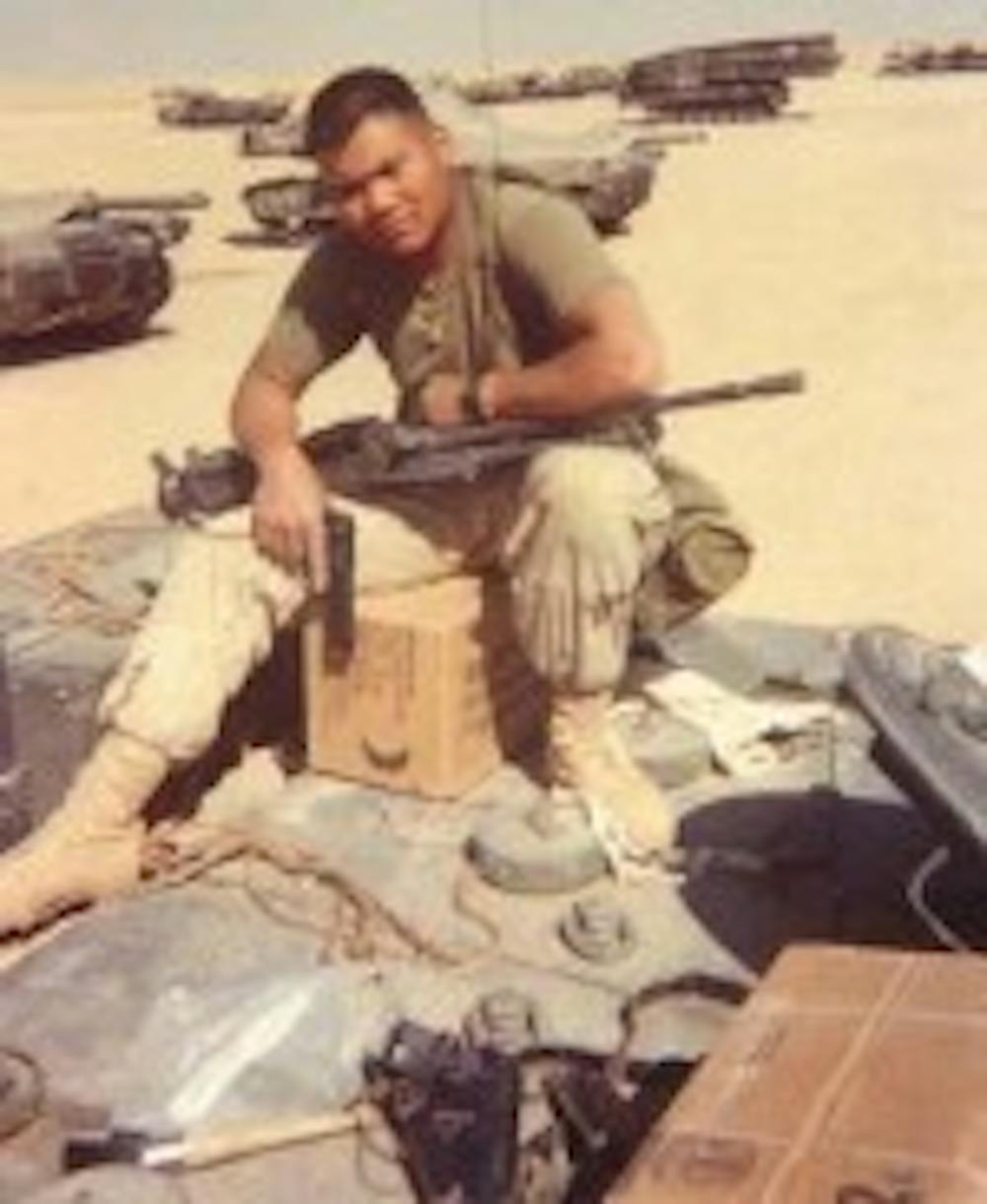
At 20 years of age, Jimmy Inthanongsak found himself in the position of having to write out a will.
A short while later, he was living on a tank fighting hostile Iraqi forces, thousands of miles away from a college life of classes, parties and exams. Sand, scorpions and the stinging chatter of AK-47 gunfire became his daily life. As a member of the 2nd Tank Battalion, 1st Marine division from Feb. 2003 to July 2003, Jimmy became a part of history.
Jimmy, who is now a junior history major at UB, was one of the first U.S. soldiers to cross into Iraq. His battalion was part of the assault on Baghdad.
"I saw everything. We were there from the beginning," he said.
Leaving home
Jimmy joined the Marines during the second semester of his freshman year, before the events of Sept. 11.
He was at Marine Combat Training at Camp Lejeune in North Carolina at the time of the attack, and did not hear about it until two days later.
"It was pretty shocking. It silenced the whole hall," he said. "It was a wake-up for what the whole training was for. It was pretty scary."
After three months of training in Fort Knox, Ky. Jimmy returned to Elmira, where he enrolled in community college and returned to a semblance of normalcy.
Come Jan. 2003, the orders he had awaited arrived. "Gentlemen, consider yourselves deployed," announced his company commander.
"The next 72 hours was all about family," Jimmy said, who then had to quit his job and withdraw from classes.
Jimmy's family, who is from Laos and has a long tradition of military service, was apprehensive at first - his mother even told him that he wasn't going.
"My mom was freaking out," he said. "Everything she said jerked at my heart a little bit because she didn't want me to go."
Although his mother's words affected him, there was not much he could do. Jimmy remembered thinking, "Mom, I can't go up to my company officer with a note from my mom and tell them I can't go."
It wasn't just family members who were concerned to see Jimmy heading to the desert - Jimmy's best friend of 12 years, John Zick, said the news of his friend's deployment was hard to take, although everyone had been expecting it.
"It only takes one shot and he's killed," he said. "We had to hope for the best, that's all we could do."
That weekend, Jimmy also had to write out a will.
"It was kind of weird being 20 years old and writing out my will," he said. "That was hard to imagine."
Before boarding the bus back to Camp Lejeune in North Carolina, Jimmy said his father gave him a pouch containing a piece of a broken tooth, a tradition started by his grandfather. "I'm always going to be with you," his father told him.
As the bus drove towards the Pennsylvania border, they passed city cops, state troopers, and sheriffs lined up in a formation outside their patrol cars saluting his unit. They stretched for half a mile along a median on Route 81.
"It felt good to be a part of that, it is something I'm always going to remember," Jimmy said. "(The bus) was pretty quiet going past those guys."
After such a warm parting, Jimmy said even the most macho unit members took their turns going into the bathroom to collect themselves.
First mission
After a nerve-wracking flight, the troops landed in Kuwait. They were driven on street buses, with the shades down, to a remote area.
"As soon as I stepped off the bus I took a 360-degree turn and all I saw was sand. That's when I knew we were the first guys out there," he said.
Two weeks after they arrived, a 3 a.m. order came to grab everything they would need for the remainder of the trip and to prepare their weaponry and move out. It brought Jimmy's training to a screeching halt.
"The war starts today," he was told. "We start the assault tonight."
By the time the sun had come up, Jimmy's battalion and an infantry army had reached the border of Iraq. They were among the first troops to enter the country.
The military game plan was for British forces to come from the east, the U.S. Army from the west, and U.S. Marines to take up the middle of Iraq, all three eventually meeting in Baghdad.
For the next few months, Jimmy became one with his tank, using it as shelter with three other men, completing various missions with his battalion.
Their first mission was to take over a highway between An Nasiriyah and the nearby Al Basra airport.
"We had to breach the border," he said. "It was pretty much a bombardment."
The troops created a column formation of vehicles; aircraft flew overhead. Fences had to be broken down and tanks were spread out to form a roadblock. The troops were instructed to let civilians pass, but not enemy forces.
Three hundred prisoners of war were captured. In one instance, an Iraqi commander and a younger gentleman came driving up on a motorcycle and surrendered their entire army. Later, a dump truck came barreling through, and twenty armed men were found in the back.
After that, the entire battalion rode through much of Iraq on the highway. Tanks were on the side and Humvees took the middle.
"It was pretty much a show of power," he said. "At that point I got really excited. First mission successful."
Daily life
As each day in Iraq went by, life as a student in the United States became a relic of time for Jimmy.
"I couldn't really keep track of time because we weren't sleeping," he said. "I was always moving."
"The only days I knew were yesterday, today, and tomorrow," Jimmy added. "Some kept journals. I lived day by day."
Because the Iraqi military did not have air units, the battalion's worst enemies came in the form of ambushes of men on foot and indirect fire.
Jimmy and the rest of the troops grew to decipher the "good" booms from the "bad" booms. He said his best days were those he wasn't shot at.
"It's a shock to the system, being 21 years old and getting shot at," he said.
Throughout the assault, Jimmy admitted to having his reservations about what was going on. But when the British and American forces reached Baghdad from all sides, overthrowing dictator Saddam Hussein and his regime, he said he knew he had done the right thing.
"I remember looking to my left seeing an old man with tears in his eyes," he said.
After refueling in Baghdad, they moved on to take over what Jimmy called an "anti-air school." At that time, Jimmy and his comrades hadn't showered in months. A plumber by occupation was among them and swiftly set one up.
"It was the best shower I ever had even though we were getting attacked," he said.
Mid-shower Jimmy found himself running back to his tank, towel around his waist, helmet on his head and his belongings in one arm. "It was so worth it," Jimmy said with a smile.
Jimmy's next mission was in Tikrit, helping to create a diversion so that the special ops could recover U.S. POWs. From there, he spent two weeks in Samara before returning to Kuwait.
In Samara, their mail finally started catching up with them. Most letters Jimmy received were from friends and family telling him they missed him and wanted him to come home. Others were from schools, children, and churches.
"I learned a lot out there about myself and my friends," he said. "They're the cheapest jerks I ever met," he said laughing. His friends sent him packages of used books, magazines, and cigarette cartons.
Jimmy, who lost 30 pounds over the course of the assault, reveled with his comrades in the luxuries of hot water, warm food, and air conditioning.
"We had totally forgot how good life could be," Jimmy said, smiling at the memory.
A co-worker sent him a butterfly kite so he took it out for a spin. His comrades were awestruck, saying, "You're supposed to be the most vicious thing on this planet, and you're flying a kite!"
When the time came to leave, Jimmy said it was difficult to leave the tank that had protected and sheltered him, which they had dubbed Baby Jackbone after the gunner on their tank and his newborn son, Jack.
"It was kind of like breaking up with an old girlfriend," Jimmy said.
Parallel worlds
The entire highway was shut down as Jimmy and his unit, surrounded by a 30-car escort, were bused back to Syracuse.
"Welcome Home" banners and Jimmy's friends and family from all parts of the world awaited his return. Among the friends was John Zick, who said that while he wouldn't want to see any of his friends in danger, Jimmy was "the best equipped to handle any situation."
Currently, Jimmy continues to juggle military and civilian life, working, attending UB, and reporting to monthly training sessions in Syracuse. He reports to Fort Drum for two weeks in the summer.
"Looking back I see how character building it was. It's total night and day. I was a total wreck before," he said. "I played a part of history, that is an accomplishment in its own."
Even now, the memories of those six months creep up on him.
"There's not a day that goes by I don't think about it," he said. "There was something to remember every day we were out there."
Some memories are better than others. Some nights he cannot sleep, and mentally he is drained.
Jimmy said he likes to keep a low profile about his harrowing encounters as he has blended back into college life.
"The media is reporting a lot of the bad things that went on," he said. "(But) anything we destroyed we paid for and gave them extra."
"Just leaving them alone won't work because it will leave them open for civil war," Jimmy continued. "There's going to be someone else wanting to take over."
As a Marine, Jimmy said he never questioned his involvement in the war.
"It was always a sense of duty for me. It was that sense of duty that kept us together, and focused and kept our morale up," he said. "We're not an extension of what a politician says."



