
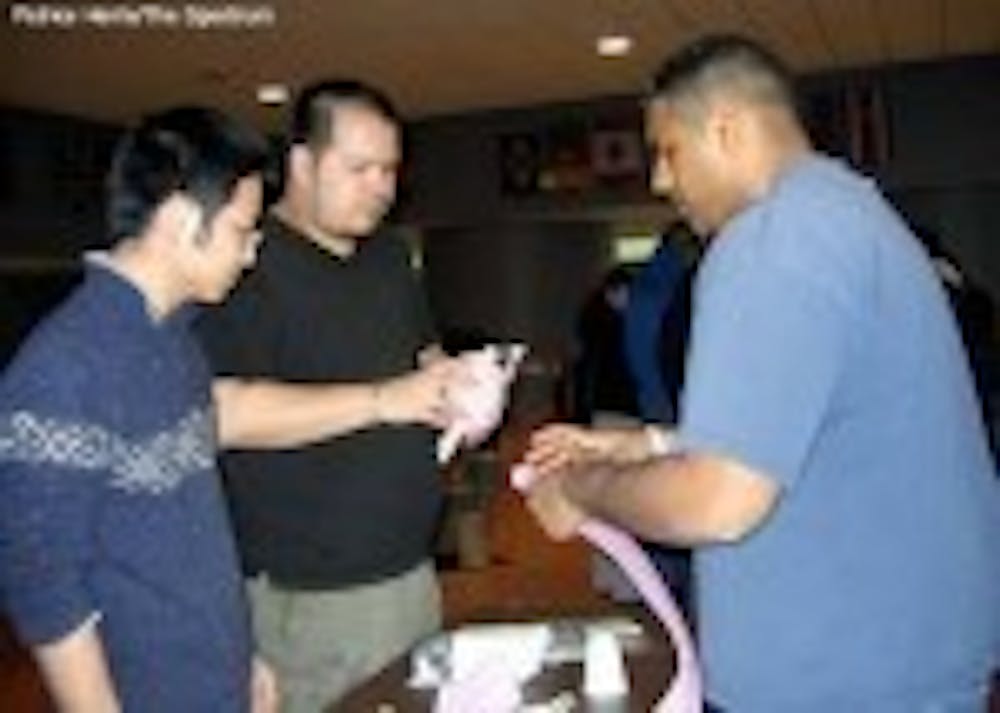
Derek Ofori leaned over the railing, took aim and let go.
His first concern was that his team's egg - shielded by Styrofoam, coffee stirrers, two cups, a latex glove and string - would shatter at the end of its three-story plunge.
But Ofori also hoped students watching his contraption hit the ground saw more than just an unusual event in the Student Union.
"Engineers are not always building these crazy, complex designs," said Ofori, a senior electrical engineering major. "When it boils down to it, it's just simple concepts."
By getting back to the basics on Tuesday, Ofori's team joined 15 others to kick off National Engineers Week and give some publicity to the fields of engineering with an egg drop competition in the Student Union.
The concept of the egg drop was to build a contraption from scratch that protects an egg when dropped from the third floor to the lobby. Each team received same materials, including one egg, and was allowed one drop.
Event organizer Jim Stanley said getting students interested in engineering was only one of the event's goals.
"It's just to let everyone know about engineering and to get the clubs out there," said Stanley, the engineering clubs coordinator for the Student Association. "On Monday during Bot Wars, when all the robots are smashing each other apart, that's the biggest event and it gets everyone's attention."
Bot Wars will culminate the week and see the crowning of an E-week champion when all the teams' points are totaled from the egg drop, Wednesday's consumable tower contest, and Bot Wars.
Contestants in Tuesday's drop were awarded points for target accuracy, contraption weight, and whether the egg stayed intact.
Competition aside, many participants said it was the challenge of designing with limited resources that made the event fun.
"We're engineers. That's what we do," said Nitin Mistry, a senior electrical engineering major with the Institute of Electrical and Electronic Engineers. "And it's a good chance for all the club members to do something together."
"There's always something new," he added. "It's never the same design."
Mistry said he's been interested in engineering since he was a kid, taking his mother's toaster and hair dryer to experiment.
"On would be off and off would be on, but it would work," Mistry said.
Whether they've been into engineering since childhood or picked up the interest in high school, participants now doing complex projects in college classes said they relished the opportunity to do something different.
"It's something to do between classes," said Charles McClive, a senior chemical engineering major with the American Institute of Chemical Engineers. "I like doing stuff that's fun to do and still theoretically educational."
McClive said these events give engineering students a chance to step outside their majors and work in groups on something that might not be their strong suit.
After drawing a rough blueprint, McClive and his teammate, senior Chris Kahanic decided to suspend the egg with the stirring straws and Styrofoam, putting everything together in the two paper bags.
Although not helping any team, Stanley recommended, from past experience, focusing on shock absorption and padding is the way to go since "the more space there is between the egg and the ground, you get a spring." Using a parachute works, but you lose accuracy, he said.
One by one, the teams launched their contraptions to either the cheers or disappointed groans of onlookers as eggs came out of the crashes either intact or leaking yolk.
Ofori's egg hit the ground with a dull thud and didn't survive the landing, but he and his teammates said they were happy with their contraption's accuracy and light weight.
"The most fun part is to implement my ideas and, hopefully, it works," he said.



