
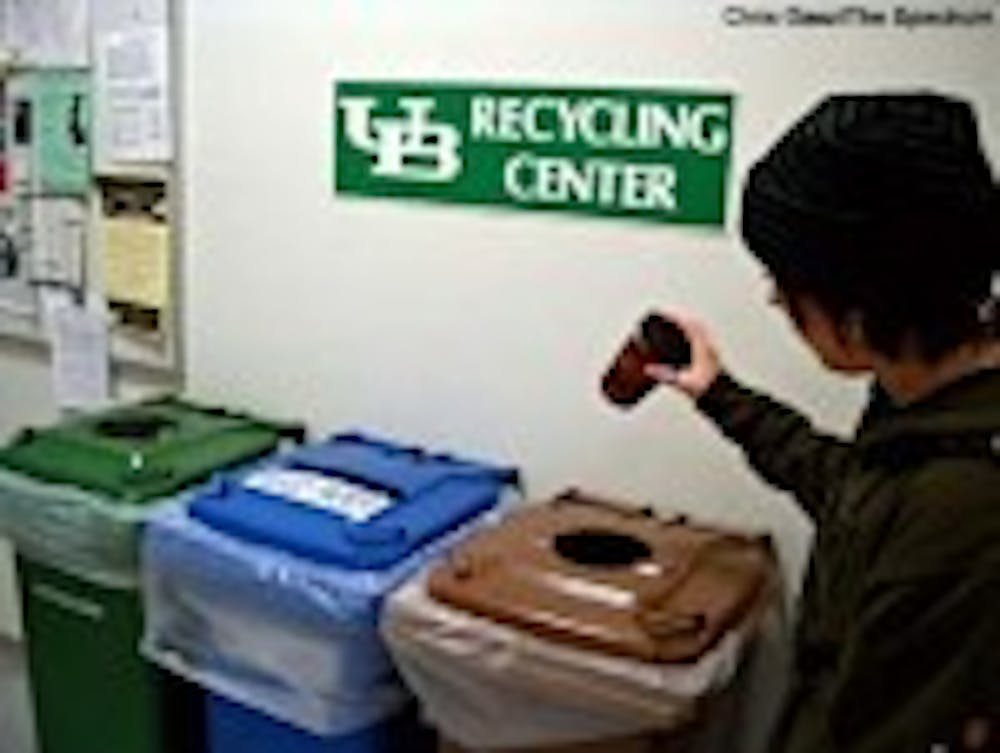
Although blue recycling bins are placed throughout residence halls and on-campus apartments, UB officials say students and custodians just aren't getting the job done.
Officials point to numbers that say UB is recycling just above 30% of total waste, instead of the 50% it is mandated to recycle.
While UB pays for a service to pick up recyclables, often they end up getting thrown out with the trash. Both officials and students say the blame lies with poor communication and student apathy.
Garry Soehner, associate director for residential student services, said the recycling program is inconsistent and correcting it should involve both students and custodial staff.
"A part of my job is to make the recycling program better and right now, I would describe the recycling program as inconsistent," Soehner said. "Part of the problem is that custodians are expected to keep the place clean and recycling doesn't get as much attention as it should."
One custodial staff member, who wished to remain anonymous, said recycling in the dorms is not an issue that is stressed and is not something custodians focus on. Keeping their specific areas clean and sanitary is their first priority, the custodian said.
"We are really short-staffed and we have to worry about cleaning the lounges, stairwells, and the bathrooms so we don't focus on recycling," the employee said. "Also, the recycling issue is never brought up at meetings with management because there are always more important topics to be dealt with."
Reasons for inconsistency
Soehner said two years ago, there were students hired by the housing department who were in charge of making sure recyclable materials were brought to their appropriate locations, but this program is no longer in effect.
"When we had students working for us, the recycling program was doing very well because they worked hard at making sure the job got done," Soehner said. "But now, if the custodians have to deal with cleaning and recycling, the cleaning will get more attention."
Soehner said both the lack of staff and student apathy contributed to the inconsistency.
"In order to have a successful recycling program, we need all levels of cooperation from students and from staff," Soehner said. "That is why re-hiring students for this specific responsibility will help ensure that the recycling gets done."
Between $550 and $600 of the residence halls' monthly operating budget is designated to pay the Modern Corporation, a disposal company that picks up recyclable materials from the loading docks, Soehner said.
Soehner added some areas are better than others because certain custodians focus on cleaning and recycling in their areas, while some neglect the recycling component.
John Hayes, assistant director of buildings and grounds and chairman of the campus-wide recycling committee, said the Governor's Executive Order 142 demands exactly 50 percent of total waste on campus must be recycled. UB's numbers have only reached above 30 percent.
"We are currently recycling at a rate of 35 percent and in order to improve, we are looking for larger gains from the student population as well as from the custodial staff," Hayes said.
Hayes said the behavior of the custodial staff and students is something that needs to be corrected with training and education.
Annually, the university spends close to $455,000 for solid waste and recycling disposal, including the cost of garbage dumpsters, landfill and labor associated with recycling and collecting the trash, Soehner said.
Although the residence halls have been inconsistent with recycling some materials, Soehner said they are making the attempt to stay environmentally friendly.
"The housing department uses Enviro 100 paper, which is made from 100 percent recycled paper and that is important because we go through a great deal of paper in a day," Soehner said. "We also try to recycle what we can, such as bed frames, construction materials, clothing and much more."
Problems for students
James Simon, treasurer for the UB Environmental Network and a student assistant for UB Green, said the dorms do present problems for those who want to recycle.
"Recycling is a really important and visible part of what UB Green does and we realize that the residence halls is an area where the recycling is inconsistent, but that is something that we are currently working to correct," Simon said.
Although the lack of recycling can be blamed on the staff, some say it's the students' responsibility.
"I think UB can better educate students about recycling," said Annie Kim, a graduate student. "I feel like it's mostly up to our own discretion and unfortunately the average student doesn't care about recycling as much as they should."
Some students said there is no way to force an individual to recycle, even with the appropriate tools.
"I don't think you can force anyone to recycle but there are a lot of places where bins and cans are labeled for different materials," said Benjamin Varghese, a senior accounting major.
Soehner said the housing department welcomes opinions of students who are interested and willing to help fix the problem.
"We want to know what the students think and we do try to get student participants to voice their opinion on recycling," Soehner said. "We want to make the recycling program more consistent and we are trying to find a better way to do things."



