
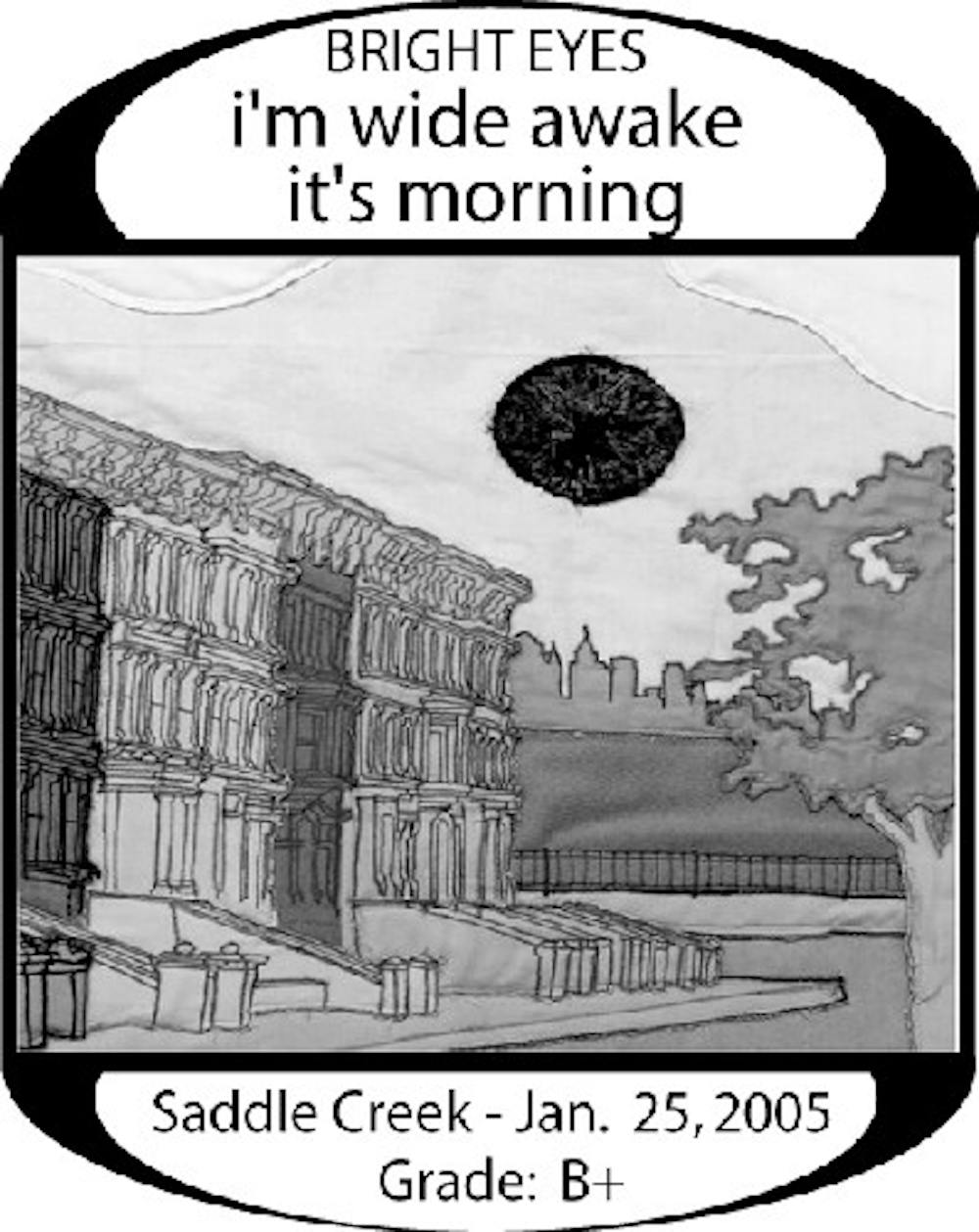
Bright Eyes' founder Conor Oberst is known for two things: his writing and his over-the-top tender delivery. To be sure, the accompaniment he finds for his group is compelling and beautiful, but without spectacular writing and a unique voice, Bright Eyes the body loses its heart and its guts.
Therefore, most of the commendations Bright Eyes' new LP "I'm Wide Awake, It's Morning" is bound to earn will be by Oberst's merit. The album is the counterpart to an uncharacteristically synthesized work, "Digital Ash in a Digital Urn.
The album is a collaboration of 15 musicians, including Oberst, playing 11 instruments, including a Rhodes organ, a mandolin and a vibraphone.
The start of "I'm Wide Awake, It's Morning" is going to piss off some people. Others may not be able to contain their joy. Oberst preludes the first song, "At the Bottom of Everything," with a short story about two people on a plane that's about to crash. He tells it in his pre-adolescent voice with childish word selection, a combination that will annoy some but probably delight his diehards. The ensuing song features My Morning Jacket member Jim James' guest vocals. The two distinct voices compliment each other in a way that is uncommon. Stylistic singers like these don't usually mesh well. These guys do.
Oberst's lyrics on the album are definitely "notebook," meaning his words often come across as thoughts that occur to him as he carries his pad and pen in his messenger bag.
"Now the ocean speaks and spits and I can hear it from the interstate/ I'm screaming at my brother on the cell phone, he is far away/ I'm saying, nothing in the past or future ever will feel like today," he sings on "Another Travelin' Song." He keeps a lot of description in his words. He always has, but that doesn't mean he's not capable of poignant narratives.
"And if you swear that there's no truth and who cares/ Why do you say it like you're right?/ Why are you scared to dream of God when it's salvation that you want?/ Like stars that clear have been dead for years, but the idea lives on," he sings on "We Are Nowhere and It's Now," one of three tracks featuring Emmylou Harris.
Oberst showcases a number of lyrical themes. He pumps up the hope, more often writing about his one-day-at-a-time outlook, which aids him in his bouts with depression. He turns down, but not off, the references to drug use and loneliness, as well as his other method of overcoming depression: alcohol. He also finds a completely new subject on which to focus the bite of his sarcasm, adding to ex-girlfriends and himself. He shows an expansive, if not unique, resentment of war. To which could he possibly be referring? It is also worth noting that the title of the "standout track" is an allusion to Beethoven's "Ode to Joy."
A few of the songs here are downright gorgeous. Most of them, though, are just plain "nice." There is a tasteful insertion of classic country textures, exquisitely produced, allowing every steel guitar and harmonica note to ring out in its clarity.
Standout Track: "Road to Joy"



