
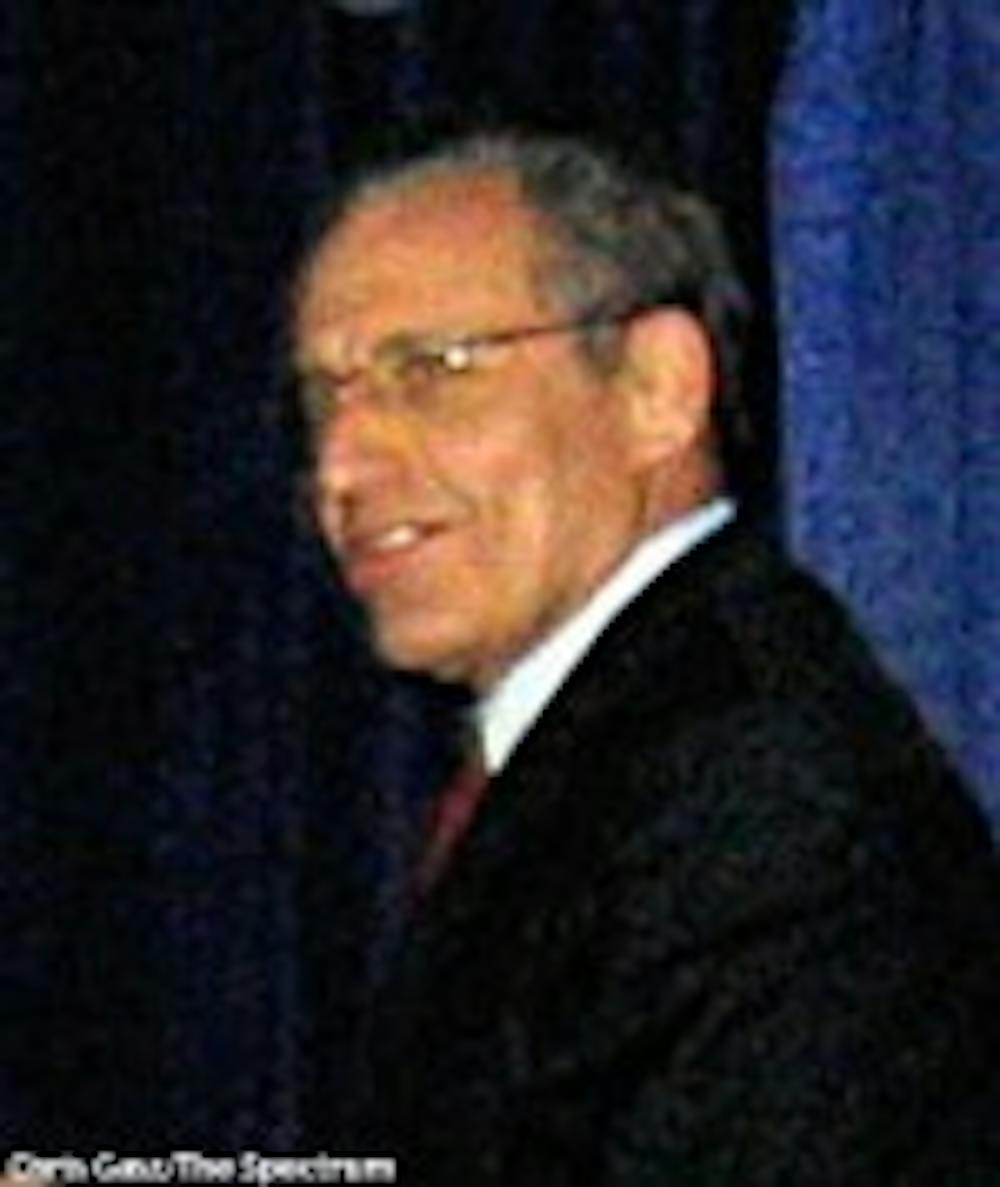
Drawing on an extraordinary amount of first-hand interviews, famed journalist Bob Woodward gave insight into the presidency of George W. Bush Wednesday night in Alumni Arena as part of UB's Distinguished Speaker Series.
An award-winning investigative journalist and author, Woodward is probably best known for work with Carl Bernstein to unravel the Watergate scandal, which forced Richard Nixon from the presidency in 1974. Woodward's latest book, "Plan of Attack," takes a close look at President George W. Bush's decision to go to war in Iraq.
Woodward offered an insider's point of view - a unique and personal look at Bush and what the President stands for. Woodward said going into the most recent interview with Bush, the main question the back of his mind was, who really is George W. Bush?
Much of Woodward's speech pulled from his latest book, which examined the road to war in Iraq. For the book, Woodward gained access to countless previously classified documents and spoke to many within the administration, but the interview with Bush himself had a tremendous effect on Woodward's opinions.
"The lesson for him of the 9/11 attack was to take the threats out early," Woodward said.
Woodward highlighted the importance of "duty" and "zeal" to Bush, and said people should watch for those two words popping up often in his second term.
In questioning the President's swift decision to go to war, Woodward said he soon learned that Bush had "no doubt" whatsoever in his decisions. During their interview, Woodward said he read Bush a quote by British Prime Minister Tony Blair in which Blair admitted to having doubts, but Bush would admit to no such thing.
Woodward also pointed to an August 2002 report from Secretary of State Colin Powell in which Powell laid out the Pottery Barn rule: if America were to "break" Iraq, it would own it. If anything else, that meeting with Powell, in which he presented all the consequences of invading Iraq, should have given Bush pause, Woodward said.
"It is possible, given Bush's determination, there was no way to stop this war," he said.
Though Woodward said the Iraq war is a "mess" and blamed Bush for ignoring dissenting voices, he said that the president showed resolve and determination in the way he executed the war.
"The most important trait a president can have is courage, and sometimes courage means walking the road alone," Woodward said.
Woodward acknowledged that democracy may eventually come to Iraq, and how history looks back on Bush's two terms is still to be determined. He noted that during their time in office, even now-celebrated presidents like Abraham Lincoln and Harry Truman were considered extremely unpopular.
For trying to save the Union, "we thought Lincoln was mad in his time," Woodward said.
Looking back on his career, Woodward said neither Bush nor Sen. John Kerry was as "wrong" a candidate as Richard Nixon was over 30 years ago. Nixon, he said, was a president of hate and revenge, two principles that both Bush and Kerry did not have as politicians. Both 2004 candidates thought in terms of grandiose plans for the greater good, which is how many Americans view the job of the president.
"(Nixon) never had a sense of what the presidency could do in terms of good," Woodward said.
The evening concluded on a humorous note when one student asked the inevitable question: who is Deep Throat, the anonymous inside source that helped break Watergate?
"I thought I was going to escape," Woodward laughed, saying that Deep Throat's name would only be revealed when the source either died or changed his mind.
Following the event, reactions from the audience were mixed.
"I thought it was very informative, very interesting," said Bob Spuller, a UB graduate of 1987. "I thought it was very interesting how he defined Bush as someone determined to go to war without any broad sense of thought."
"I knew that he was involved with Watergate, but I did not know he was so involved with current presidential affairs," said Joe Davis, a junior media studies major. "I'm glad I came because I was exposed to things about Bush and the war I wouldn't have been aware of otherwise."
Others said they were hoping for more from Woodward.
"I was disappointed in him," said Carole Telesco, a retired schoolteacher from Amherst. "I expected more than generalities and so much emphasis on his latest book.
"He's a good speaker," she added, "but he disappointed me."



