
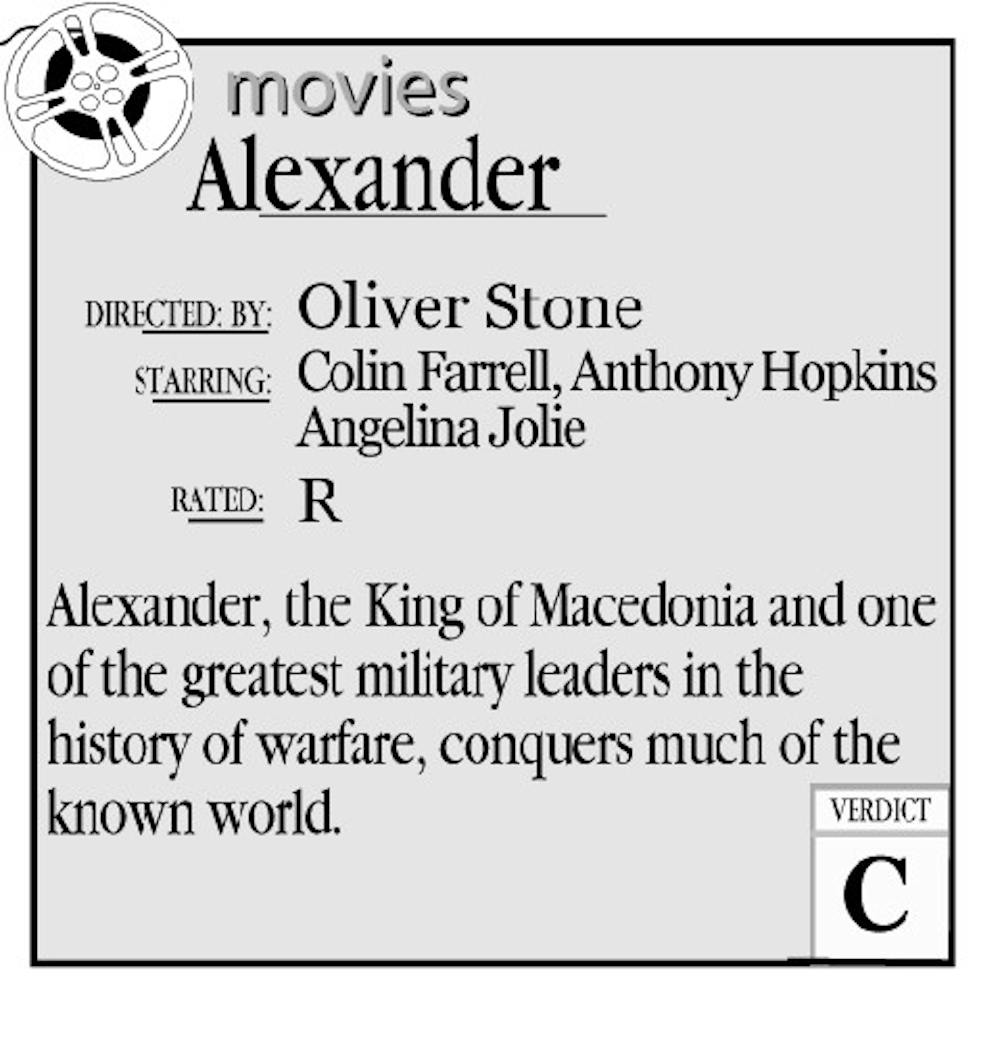
If Alexander the Great were alive to see "Alexander," he just might jab Colin Farrell with the sharp end of his spear.
The blame for the failure of "Alexander" does not rest solely on the shoulders of Farrell. There is a world of problems in the movie heavy enough to splatter the mighty Atlas between a rock and a hard place.
Oliver Stone ("Platoon") is the latest director to take a stab at the epic genre, which is a growing trend among Hollywood's aging filmmakers. Martin Scorsese's "Gangs of New York," Ridley Scott's "Gladiator," and Wolfgang Peterson's "Troy" are all directed by men eligible for a senior citizen coffee discount at McDonalds. Directing an epic is Hollywood's way of buying a Corvette during a mid-life crisis.
Although the epic genre has been around since the days of "Lawrence of Arabia" and "Spartacus," the genre took off with the release of "Braveheart" in 1995. Since then, movie execs became less fearful of taking on expensive, and expansive, projects.
Epics have almost guaranteed box office success. Moreover, with the technological innovations unveiled in the "Lord of the Rings" trilogy, moviemakers felt that they could recreate epic scenes with CGI armies and contemporary special effects. Suddenly, anything was possible.
And who better to put the responsibility of the new wave of epic movies into the wrinkled hands of Hollywood's elderly?
Stone casts Farrell ("Phone Booth") as the blonde-haired version of William Wallace to play the godlike Alexander, who has the strength and ambition of a deity, but the flaws of a man.
Unfortunately, Farrell has been the flavor of the month for four years now, somehow remaining popular with a r?(c)sum?(c) of sub-par movies and mediocre acting. There's a bevy of actors, known and unknown, that could have better filled the role.
The movie follows Alexander from his early boyhood to his death at age 33. Despite the short span of time, the film tries to cover too much material in too little time, even over the course of three hours.
Anthony Hopkins ("Nixon") plays Ptolemy, an old friend and general of Alexander who narrates the film. His narration is filled with psychological blather and enough sleep-inducing discourse for the audience to weigh the benefits of a mid-movie siesta.
Olympias is Alexander's mother, played by Angelina Jolie ("Girl, Interrupted"). She sows the ambitious dreams into young Alexander while at odds with her husband, Phillip II, played by Val Kilmer ("The Doors"). Jolie does well in portraying a strong and misunderstood character but her phony accent and spells of overacting detract from a fairly decent performance.
Kilmer on the other hand does a magnificent job as the one-eyed king. His character is fragmented by the burden of power and love of his son. When Phillip II was assassinated, Alexander, just old enough to drink today in Canada, is itching to begin his conquest to rule the known world.
His conquest begins at the Battle of Guagamela where Alexander sought to defeat a Persian army of over 250,000 soldiers with just over 45,000 of his own Macedonian troops. Everything good about the movie is tightly jammed into this 10-minute scene.
The blood, guts and gore of the battle were a visual spectacle worthy of thumbs-up approval from a blood-lusting Coliseum crowd. Stone made a complex battle easy to follow by making good use of CGI. He framed the vast scope of the battle with a landscape covered by a sea of soldiers, while intermittently zooming in on the carnage of up-close battle.
Unfortunately, the rest of the movie drags from one scene to the next as Stone tries to weave together a series of themes and subplots that result in an entangled mess.
Stone is constantly dangling the idea of Alexander's homosexuality in front of the audiences' noses with countless suggestive glances, innuendo and enough physical contact to have homophobes shifting in their seats.
Why Stone presents Alexander's sexuality as a constant theme is unknown. Alexander's homosexuality, like other epic heroes' heterosexuality, neither reflects their characters' personas at all, nor matters.
After numerous homoerotic scenes, the audience got the idea. Alright, he's gay already! Get on with the movie!
Instead, Stone tries to create an epic masterpiece by attempting to shed light into the psychological prism that made Alexander historically ambiguous. His psychology, though, was left undiagnosed and the intellectual quality of the film was left hollow.
The rapidly growing genre is swiftly growing stale, as more movies of epic proportions prove impotent in realizing their visions. It might be time to mix it up with some younger directors with fresh creativity and new ideas to revitalize a genre that has the ability to show the brighter side of Hollywood.



